{"id":10945243152543,"title":"Antique Victorian Ashworth Imari-Style Ironstone China Plate, c.1862–1890","handle":"antique-victorian-ashworth-imari-style-ironstone-china-plate-c-1862-1890","description":"\u003cp\u003e\u003cmeta charset=\"UTF-8\"\u003e\u003c\/p\u003e\n\u003cp data-pm-slice=\"1 1 []\"\u003e\u003cspan\u003eTurn this plate over and its English origins are revealed. The exuberant Japanese-inspired decoration belongs to the world of Imari, but the impressed Ashworth mark places it firmly in Staffordshire, where the nineteenth-century appetite for Oriental design had inspired a flourishing ceramics industry.\u003c\/span\u003e\u003c\/p\u003e\n\u003cp\u003e\u003cspan\u003eThis is more than a fashionable imitation. G. L. Ashworth \u0026amp; Bros. inherited the original moulds, copper printing plates and patterns of Charles James Mason, whose innovative ironstone china had transformed English pottery earlier in the century. Ashworth continued that tradition, combining the durability of ironstone with the rich colours and elaborate decoration that made Mason's wares so popular.\u003c\/span\u003e\u003c\/p\u003e\n\u003cp\u003e\u003cspan\u003eThe plate captures that decorative ambition particularly well. The richly decorated cobalt-blue border, with its salmon-coloured scrolls and gilded details, surrounds a central vase of flowers. Here, much of the original hand-painted enamel and gilding has worn away, revealing the delicate printed outlines beneath. The surviving decoration offers an interesting glimpse into the techniques used to produce these elaborate Victorian patterns.\u003c\/span\u003e\u003c\/p\u003e\n\u003cp\u003e\u003cspan\u003eMade during the Victorian period, when Japanese and Chinese-inspired ceramics were firmly established in fashionable English interiors, it brings together two distinct traditions: the decorative brilliance of Imari and the technical ingenuity of Staffordshire pottery.\u003c\/span\u003e\u003c\/p\u003e\n\u003cp\u003e\u003cspan\u003eA piece that offers more than decorative appeal, it carries a tangible connection to the extraordinary exchange of ideas that shaped nineteenth-century English ceramics.\u003c\/span\u003e\u003c\/p\u003e\n\u003cp\u003e\u003cspan\u003e\u003c\/span\u003e\u003cstrong\u003e\u003cspan\u003eMaker:\u003c\/span\u003e\u003c\/strong\u003e\u003cspan\u003e G. L. Ashworth \u0026amp; Bros.\u003c\/span\u003e\u003cbr\u003e\u003cstrong\u003e\u003cspan\u003eDate:\u003c\/span\u003e\u003c\/strong\u003e\u003cspan\u003e c.1862–1890\u003c\/span\u003e\u003cbr\u003e\u003cstrong\u003e\u003cspan\u003eOrigin:\u003c\/span\u003e\u003c\/strong\u003e\u003cspan\u003e Hanley, Staffordshire, England\u003c\/span\u003e\u003cbr\u003e\u003cstrong\u003e\u003cspan\u003eMaterial:\u003c\/span\u003e\u003c\/strong\u003e\u003cspan\u003e Ironstone china\u003c\/span\u003e\u003cbr\u003e\u003cspan\u003e\u003cstrong\u003eDiameter:\u003c\/strong\u003e\u003c\/span\u003e\u003cspan\u003e 22.5 cm (8.9 inches)\u003c\/span\u003e\u003cbr\u003e\u003cstrong\u003e\u003cspan\u003eDecoration:\u003c\/span\u003e\u003c\/strong\u003e\u003cspan\u003e Imari-style cobalt blue with iron-red, salmon and gilt decoration\u003c\/span\u003e\u003cbr\u003e\u003cstrong\u003e\u003cspan\u003eMarkings:\u003c\/span\u003e\u003c\/strong\u003e\u003cspan\u003e Impressed ASHWORTH \/ REAL \/ IRONSTONE \/ CHINA, with additional hand-painted iron-red mark to the base\u003c\/span\u003e\u003cbr\u003e\u003cstrong\u003e\u003cspan\u003eCondition:\u003c\/span\u003e\u003c\/strong\u003e\u003cspan\u003e Good antique condition, with noticeable rubbing and loss of overglaze enamels and gilding, particularly to the central floral decoration, together with age-related surface wear. Please examine all photographs carefully.\u003cmeta charset=\"UTF-8\"\u003e\u003c\/span\u003e\u003cspan\u003e\u003c\/span\u003e\u003c\/p\u003e\n\u003cp\u003e\u003cstrong\u003e\u003cspan\u003eCollector's Note\u003c\/span\u003e\u003c\/strong\u003e\u003c\/p\u003e\n\u003cp\u003e\u003cspan\u003eThe story of Mason's Ironstone China began in 1813, when Charles James Mason patented a durable ceramic body intended to combine the strength of earthenware with the appearance of fashionable imported porcelain.\u003c\/span\u003e\u003c\/p\u003e\n\u003cp\u003e\u003cspan\u003eDespite its name, ironstone china was not porcelain, nor was it made principally from iron. It was a dense, hard-wearing ceramic that could withstand everyday use while carrying the elaborate decoration previously associated with more expensive wares.\u003c\/span\u003e\u003c\/p\u003e\n\u003cp\u003e\u003cspan\u003eThe name itself was a remarkable piece of nineteenth-century marketing. It suggested both the strength of iron and the refinement of fine china, helping to establish one of the most enduring identities in English pottery.\u003c\/span\u003e\u003c\/p\u003e\n\u003cp\u003e\u003cspan\u003eWhen the original Mason business declined, its designs and manufacturing equipment passed to Francis Morley and subsequently to Ashworth. This continuity explains why many Victorian Ashworth pieces retain such a strong connection to the celebrated Mason tradition.\u003c\/span\u003e\u003c\/p\u003e\n\u003cp\u003e \u003c\/p\u003e","published_at":"2026-11-25T20:15:34+00:00","created_at":"2026-11-25T19:00:55+00:00","vendor":"Eclectic Design ","type":"Decorative Plate","tags":["19th Century Ironstone","Antique Decorative Plate","Antique English Plate","Ashworth","Ashworth Ironstone","English Imari","Hand Enamelled Ceramics.","Imari Style","Ironstone China","Mason's Ironstone","Staffordshire pottery","Victorian Ceramics"],"price":2500,"price_min":2500,"price_max":2500,"available":true,"price_varies":false,"compare_at_price":null,"compare_at_price_min":0,"compare_at_price_max":0,"compare_at_price_varies":false,"variants":[{"id":62913299775647,"title":"Default Title","option1":"Default Title","option2":null,"option3":null,"sku":null,"requires_shipping":true,"taxable":true,"featured_image":null,"available":true,"name":"Antique Victorian Ashworth Imari-Style Ironstone China Plate, c.1862–1890","public_title":null,"options":["Default Title"],"price":2500,"weight":1000,"compare_at_price":null,"inventory_quantity":1,"inventory_management":"shopify","inventory_policy":"deny","barcode":null,"requires_selling_plan":false,"selling_plan_allocations":[],"quantity_rule":{"min":1,"max":null,"increment":1}}],"images":["\/\/eclecticdesignlondon.com\/cdn\/shop\/files\/IMG_0312.png?v=1795637157","\/\/eclecticdesignlondon.com\/cdn\/shop\/files\/IMG_0313.jpg?v=1795637237","\/\/eclecticdesignlondon.com\/cdn\/shop\/files\/IMG_0314.png?v=1795637054","\/\/eclecticdesignlondon.com\/cdn\/shop\/files\/IMG_0323.png?v=1795637197","\/\/eclecticdesignlondon.com\/cdn\/shop\/files\/IMG_0319.jpg?v=1795637069","\/\/eclecticdesignlondon.com\/cdn\/shop\/files\/IMG_0317.jpg?v=1795637084"],"featured_image":"\/\/eclecticdesignlondon.com\/cdn\/shop\/files\/IMG_0312.png?v=1795637157","options":["Title"],"media":[{"alt":"Victorian Ashworth Imari-style ironstone plate with a central flower-filled vase and cobalt blue, rust-red and peach border.","id":54676100350111,"position":1,"preview_image":{"aspect_ratio":1.0,"height":2894,"width":2894,"src":"\/\/eclecticdesignlondon.com\/cdn\/shop\/files\/IMG_0312.png?v=1795637157"},"aspect_ratio":1.0,"height":2894,"media_type":"image","src":"\/\/eclecticdesignlondon.com\/cdn\/shop\/files\/IMG_0312.png?v=1795637157","width":2894},{"alt":"Close-up of the Ashworth plate’s central floral design, with outlined flowers and cobalt blue foliage in a blue vase.","id":54676106477727,"position":2,"preview_image":{"aspect_ratio":1.0,"height":1782,"width":1782,"src":"\/\/eclecticdesignlondon.com\/cdn\/shop\/files\/IMG_0313.jpg?v=1795637237"},"aspect_ratio":1.0,"height":1782,"media_type":"image","src":"\/\/eclecticdesignlondon.com\/cdn\/shop\/files\/IMG_0313.jpg?v=1795637237","width":1782},{"alt":"Close-up of the Ashworth plate’s Imari-style border, showing cobalt blue panels, rust-red scrollwork and peach decoration.","id":54676100382879,"position":3,"preview_image":{"aspect_ratio":1.0,"height":1400,"width":1400,"src":"\/\/eclecticdesignlondon.com\/cdn\/shop\/files\/IMG_0314.png?v=1795637054"},"aspect_ratio":1.0,"height":1400,"media_type":"image","src":"\/\/eclecticdesignlondon.com\/cdn\/shop\/files\/IMG_0314.png?v=1795637054","width":1400},{"alt":"Reverse of the Victorian Ashworth ironstone plate, showing the raised foot ring, impressed maker’s mark and red painted marks.","id":54676100317343,"position":4,"preview_image":{"aspect_ratio":0.999,"height":2613,"width":2611,"src":"\/\/eclecticdesignlondon.com\/cdn\/shop\/files\/IMG_0323.png?v=1795637197"},"aspect_ratio":0.999,"height":2613,"media_type":"image","src":"\/\/eclecticdesignlondon.com\/cdn\/shop\/files\/IMG_0323.png?v=1795637197","width":2611},{"alt":"Close-up of the impressed maker’s mark on the underside of the Ashworth ironstone plate.","id":54676100448415,"position":5,"preview_image":{"aspect_ratio":1.333,"height":3024,"width":4032,"src":"\/\/eclecticdesignlondon.com\/cdn\/shop\/files\/IMG_0319.jpg?v=1795637069"},"aspect_ratio":1.333,"height":3024,"media_type":"image","src":"\/\/eclecticdesignlondon.com\/cdn\/shop\/files\/IMG_0319.jpg?v=1795637069","width":4032},{"alt":"Close-up of the red hand-painted pattern marks on the underside of the Ashworth ironstone plate.","id":54676101038239,"position":6,"preview_image":{"aspect_ratio":0.75,"height":4032,"width":3024,"src":"\/\/eclecticdesignlondon.com\/cdn\/shop\/files\/IMG_0317.jpg?v=1795637084"},"aspect_ratio":0.75,"height":4032,"media_type":"image","src":"\/\/eclecticdesignlondon.com\/cdn\/shop\/files\/IMG_0317.jpg?v=1795637084","width":3024}],"requires_selling_plan":false,"selling_plan_groups":[],"content":"\u003cp\u003e\u003cmeta charset=\"UTF-8\"\u003e\u003c\/p\u003e\n\u003cp data-pm-slice=\"1 1 []\"\u003e\u003cspan\u003eTurn this plate over and its English origins are revealed. The exuberant Japanese-inspired decoration belongs to the world of Imari, but the impressed Ashworth mark places it firmly in Staffordshire, where the nineteenth-century appetite for Oriental design had inspired a flourishing ceramics industry.\u003c\/span\u003e\u003c\/p\u003e\n\u003cp\u003e\u003cspan\u003eThis is more than a fashionable imitation. G. L. Ashworth \u0026amp; Bros. inherited the original moulds, copper printing plates and patterns of Charles James Mason, whose innovative ironstone china had transformed English pottery earlier in the century. Ashworth continued that tradition, combining the durability of ironstone with the rich colours and elaborate decoration that made Mason's wares so popular.\u003c\/span\u003e\u003c\/p\u003e\n\u003cp\u003e\u003cspan\u003eThe plate captures that decorative ambition particularly well. The richly decorated cobalt-blue border, with its salmon-coloured scrolls and gilded details, surrounds a central vase of flowers. Here, much of the original hand-painted enamel and gilding has worn away, revealing the delicate printed outlines beneath. The surviving decoration offers an interesting glimpse into the techniques used to produce these elaborate Victorian patterns.\u003c\/span\u003e\u003c\/p\u003e\n\u003cp\u003e\u003cspan\u003eMade during the Victorian period, when Japanese and Chinese-inspired ceramics were firmly established in fashionable English interiors, it brings together two distinct traditions: the decorative brilliance of Imari and the technical ingenuity of Staffordshire pottery.\u003c\/span\u003e\u003c\/p\u003e\n\u003cp\u003e\u003cspan\u003eA piece that offers more than decorative appeal, it carries a tangible connection to the extraordinary exchange of ideas that shaped nineteenth-century English ceramics.\u003c\/span\u003e\u003c\/p\u003e\n\u003cp\u003e\u003cspan\u003e\u003c\/span\u003e\u003cstrong\u003e\u003cspan\u003eMaker:\u003c\/span\u003e\u003c\/strong\u003e\u003cspan\u003e G. L. Ashworth \u0026amp; Bros.\u003c\/span\u003e\u003cbr\u003e\u003cstrong\u003e\u003cspan\u003eDate:\u003c\/span\u003e\u003c\/strong\u003e\u003cspan\u003e c.1862–1890\u003c\/span\u003e\u003cbr\u003e\u003cstrong\u003e\u003cspan\u003eOrigin:\u003c\/span\u003e\u003c\/strong\u003e\u003cspan\u003e Hanley, Staffordshire, England\u003c\/span\u003e\u003cbr\u003e\u003cstrong\u003e\u003cspan\u003eMaterial:\u003c\/span\u003e\u003c\/strong\u003e\u003cspan\u003e Ironstone china\u003c\/span\u003e\u003cbr\u003e\u003cspan\u003e\u003cstrong\u003eDiameter:\u003c\/strong\u003e\u003c\/span\u003e\u003cspan\u003e 22.5 cm (8.9 inches)\u003c\/span\u003e\u003cbr\u003e\u003cstrong\u003e\u003cspan\u003eDecoration:\u003c\/span\u003e\u003c\/strong\u003e\u003cspan\u003e Imari-style cobalt blue with iron-red, salmon and gilt decoration\u003c\/span\u003e\u003cbr\u003e\u003cstrong\u003e\u003cspan\u003eMarkings:\u003c\/span\u003e\u003c\/strong\u003e\u003cspan\u003e Impressed ASHWORTH \/ REAL \/ IRONSTONE \/ CHINA, with additional hand-painted iron-red mark to the base\u003c\/span\u003e\u003cbr\u003e\u003cstrong\u003e\u003cspan\u003eCondition:\u003c\/span\u003e\u003c\/strong\u003e\u003cspan\u003e Good antique condition, with noticeable rubbing and loss of overglaze enamels and gilding, particularly to the central floral decoration, together with age-related surface wear. Please examine all photographs carefully.\u003cmeta charset=\"UTF-8\"\u003e\u003c\/span\u003e\u003cspan\u003e\u003c\/span\u003e\u003c\/p\u003e\n\u003cp\u003e\u003cstrong\u003e\u003cspan\u003eCollector's Note\u003c\/span\u003e\u003c\/strong\u003e\u003c\/p\u003e\n\u003cp\u003e\u003cspan\u003eThe story of Mason's Ironstone China began in 1813, when Charles James Mason patented a durable ceramic body intended to combine the strength of earthenware with the appearance of fashionable imported porcelain.\u003c\/span\u003e\u003c\/p\u003e\n\u003cp\u003e\u003cspan\u003eDespite its name, ironstone china was not porcelain, nor was it made principally from iron. It was a dense, hard-wearing ceramic that could withstand everyday use while carrying the elaborate decoration previously associated with more expensive wares.\u003c\/span\u003e\u003c\/p\u003e\n\u003cp\u003e\u003cspan\u003eThe name itself was a remarkable piece of nineteenth-century marketing. It suggested both the strength of iron and the refinement of fine china, helping to establish one of the most enduring identities in English pottery.\u003c\/span\u003e\u003c\/p\u003e\n\u003cp\u003e\u003cspan\u003eWhen the original Mason business declined, its designs and manufacturing equipment passed to Francis Morley and subsequently to Ashworth. This continuity explains why many Victorian Ashworth pieces retain such a strong connection to the celebrated Mason tradition.\u003c\/span\u003e\u003c\/p\u003e\n\u003cp\u003e \u003c\/p\u003e"}

Antique Victorian Ashworth Imari-Style Ironstone China Plate, c.1862–1890

περιγραφή προϊόντος
£25.00
Συμπληρώθηκε η μέγιστη διαθέσιμη ποσότητα.

Turn this plate over and its English origins are revealed. The exuberant Japanese-inspired decoration belongs to the world of Imari, but the impressed Ashworth mark places it firmly in Staffordshire, where the nineteenth-century appetite for Oriental design had inspired a flourishing ceramics industry.

This is more than a fashionable imitation. G. L. Ashworth & Bros. inherited the original moulds, copper printing plates and patterns of Charles James Mason, whose innovative ironstone china had transformed English pottery earlier in the century. Ashworth continued that tradition, combining the durability of ironstone with the rich colours and elaborate decoration that made Mason's wares so popular.

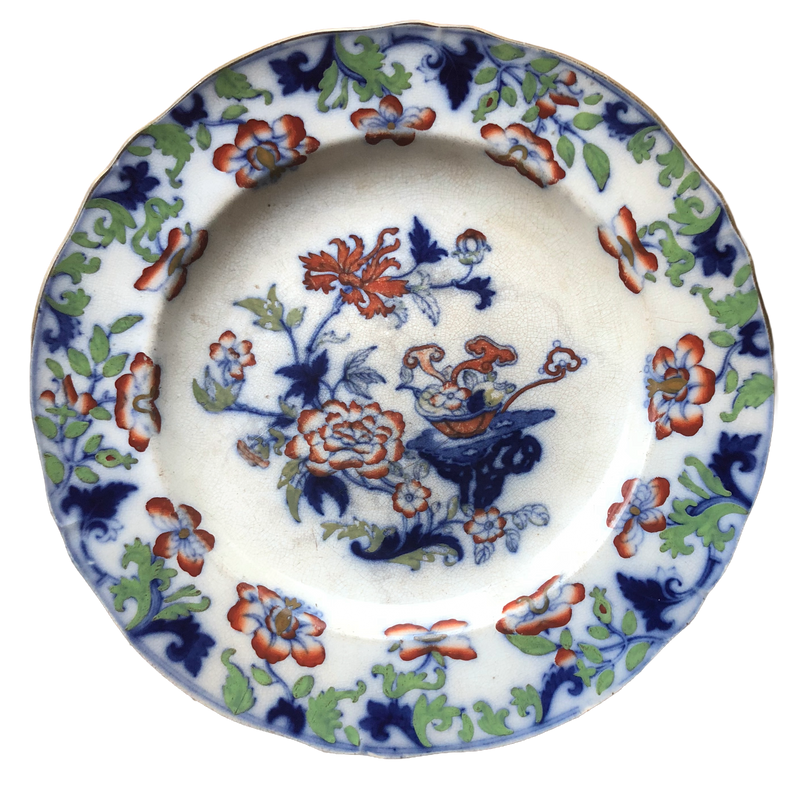
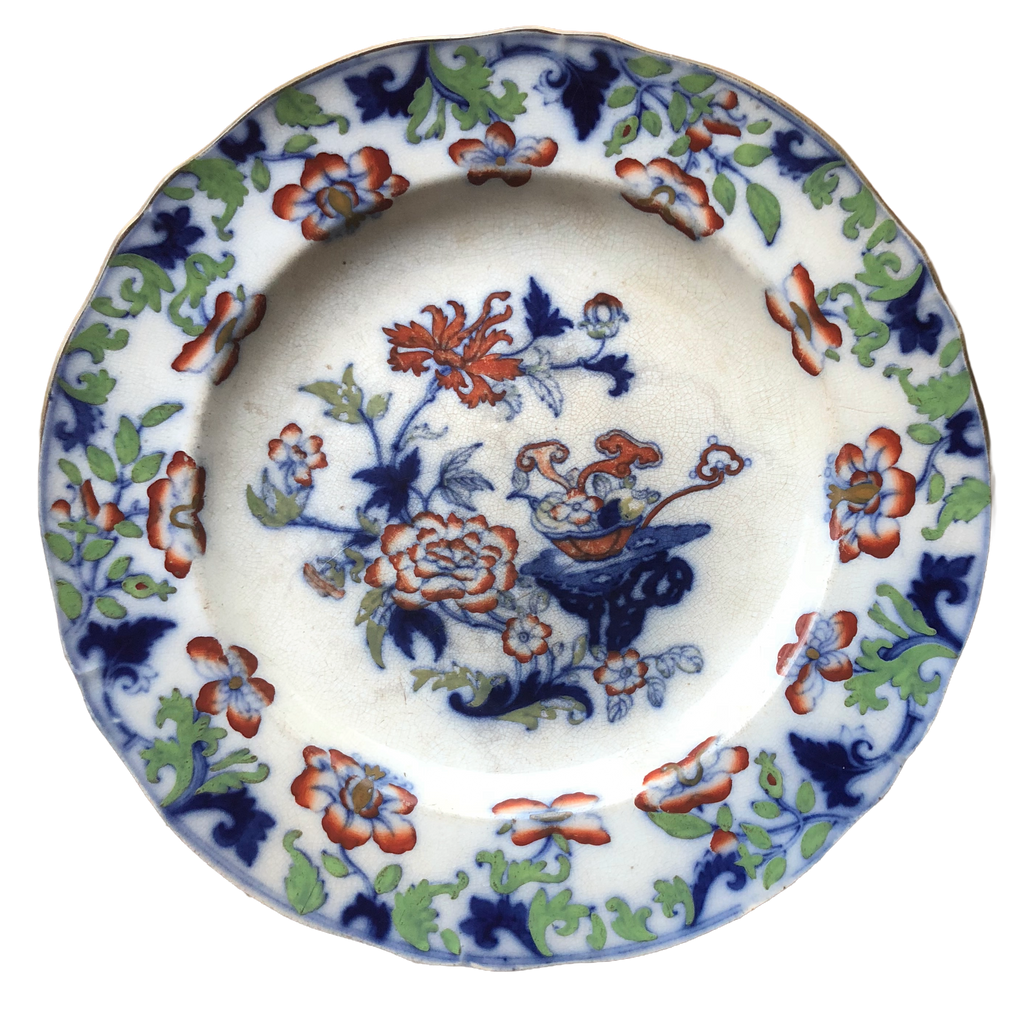
The plate captures that decorative ambition particularly well. The richly decorated cobalt-blue border, with its salmon-coloured scrolls and gilded details, surrounds a central vase of flowers. Here, much of the original hand-painted enamel and gilding has worn away, revealing the delicate printed outlines beneath. The surviving decoration offers an interesting glimpse into the techniques used to produce these elaborate Victorian patterns.

Made during the Victorian period, when Japanese and Chinese-inspired ceramics were firmly established in fashionable English interiors, it brings together two distinct traditions: the decorative brilliance of Imari and the technical ingenuity of Staffordshire pottery.

A piece that offers more than decorative appeal, it carries a tangible connection to the extraordinary exchange of ideas that shaped nineteenth-century English ceramics.

Maker: G. L. Ashworth & Bros.
Date: c.1862–1890
Origin: Hanley, Staffordshire, England
Material: Ironstone china
Diameter: 22.5 cm (8.9 inches)
Decoration: Imari-style cobalt blue with iron-red, salmon and gilt decoration
Markings: Impressed ASHWORTH / REAL / IRONSTONE / CHINA, with additional hand-painted iron-red mark to the base
Condition: Good antique condition, with noticeable rubbing and loss of overglaze enamels and gilding, particularly to the central floral decoration, together with age-related surface wear. Please examine all photographs carefully.

Collector's Note

The story of Mason's Ironstone China began in 1813, when Charles James Mason patented a durable ceramic body intended to combine the strength of earthenware with the appearance of fashionable imported porcelain.

Despite its name, ironstone china was not porcelain, nor was it made principally from iron. It was a dense, hard-wearing ceramic that could withstand everyday use while carrying the elaborate decoration previously associated with more expensive wares.

The name itself was a remarkable piece of nineteenth-century marketing. It suggested both the strength of iron and the refinement of fine china, helping to establish one of the most enduring identities in English pottery.

When the original Mason business declined, its designs and manufacturing equipment passed to Francis Morley and subsequently to Ashworth. This continuity explains why many Victorian Ashworth pieces retain such a strong connection to the celebrated Mason tradition.


Σχετικά προϊόντα