ΠΟΡΣΕΛΆΝΗ & ΚΕΡΑΜΙΚΉ

From antique porcelain and studio pottery to Scandinavian tableware and decorative ceramics, this collection brings together pieces chosen for their beauty, usefulness and enduring appeal. Some were made for everyday use, others simply to be admired, but all remain as relevant and enjoyable today as when they were first created.

ΠΟΡΣΕΛΆΝΗ & ΚΕΡΑΜΙΚΉ

Sort by:
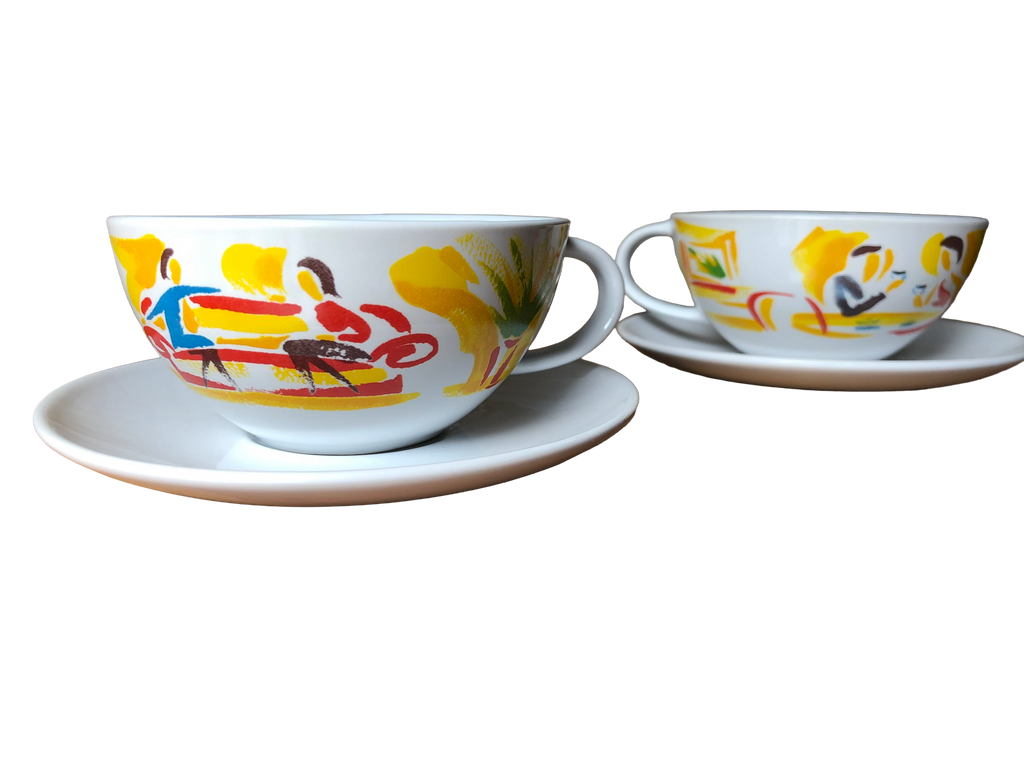
{"id":10941427974303,"title":"Vintage Nescafé Advertising Coffee Cups \u0026 Saucers, UK, c. 1988–1992","handle":"apair-of-80s-nescafe-advertising-coffee-cups","description":"\u003cp data-pm-slice=\"1 1 []\"\u003e\u003cspan\u003eThis \u003c\/span\u003evintage Nescafé promotional coffee set, dating to the late 1980s or early 1990s\u003cspan\u003e, comprises two cups and matching saucers made exclusively for Nescafé for the UK market by Hornsea Pottery.. The white ceramic is decorated with a loose, brightly coloured café scene in yellow, red, blue and brown, very much of its period.\u003c\/span\u003e\u003c\/p\u003e\n\u003cp data-pm-slice=\"1 1 []\"\u003e\u003cspan\u003eThese were not shop-bought tablewares. They belonged to the era of customer \u003c\/span\u003eloyalty\u003cb\u003e \u003c\/b\u003epromotional gifts\u003cspan\u003e, when brands encouraged customers to save labels, tokens or proofs of purchase and send away for specially produced merchandise. Nescafé was particularly good at this kind of promotion, turning an everyday jar of instant coffee into a route to branded mugs, cups and other household pieces.\u003c\/span\u003e\u003c\/p\u003e\n\u003cp data-pm-slice=\"1 1 []\"\u003e\u003cspan\u003eWhat I like here is that the branding is surprisingly restrained. Rather than covering the cups with a large Nescafé logo, the decoration plays on the idea of European café culture, with loosely painted figures, tables and flashes of colour wrapping around the cups. It feels much more like late-1980s graphic design than conventional advertising. Only t\u003c\/span\u003e\u003cspan\u003ehe bases are marked “Made Exclusively for Nescafé”\u003c\/span\u003e\u003c\/p\u003e\n\u003cp data-pm-slice=\"1 1 []\"\u003e\u003cstrong\u003e\u003cspan\u003eCondition:\u003c\/span\u003e\u003c\/strong\u003e\u003cspan\u003e Excellent vintage condition and \u003c\/span\u003eprobably never used\u003cspan\u003e. The cups and saucers remain very clean with no obvious signs of wear from regular use.\u003c\/span\u003e\u003c\/p\u003e\n\u003cp data-pm-slice=\"1 1 []\"\u003e\u003cstrong\u003e\u003cspan\u003eCollector’s note:\u003c\/span\u003e\u003c\/strong\u003e\u003cspan\u003e Promotional ceramics are easy to overlook, but they record a very particular kind of consumer history. Before loyalty apps and online reward schemes, people really did cut tokens from packaging, fill in forms and wait for something like this to arrive through the post. The result is a small but rather cheerful piece of British advertising history, and the café-style decoration has aged surprisingly well.\u003c\/span\u003e\u003c\/p\u003e\n\u003cp data-pm-slice=\"1 1 []\"\u003e\u003cspan\u003e\u003cstrong\u003eWorldwide Shipping:\u003c\/strong\u003e We are always happy to ship worldwide. Your piece will be  packed with great care and sent tracked.\u003c\/span\u003e\u003c\/p\u003e","published_at":"2026-10-25T22:38:00+00:00","created_at":"2026-10-25T22:05:24+00:00","vendor":"Eclectic Design ","type":"","tags":["advertising","coffee cups","Nescafé","saucers","UK","vintage"],"price":2500,"price_min":2500,"price_max":2500,"available":true,"price_varies":false,"compare_at_price":null,"compare_at_price_min":0,"compare_at_price_max":0,"compare_at_price_varies":false,"variants":[{"id":62896504570015,"title":"Default Title","option1":"Default Title","option2":null,"option3":null,"sku":null,"requires_shipping":true,"taxable":true,"featured_image":null,"available":true,"name":"Vintage Nescafé Advertising Coffee Cups \u0026 Saucers, UK, c. 1988–1992","public_title":null,"options":["Default Title"],"price":2500,"weight":1500,"compare_at_price":null,"inventory_quantity":1,"inventory_management":"shopify","inventory_policy":"deny","barcode":null,"requires_selling_plan":false,"selling_plan_allocations":[],"quantity_rule":{"min":1,"max":null,"increment":1}}],"images":["\/\/eclecticdesignlondon.com\/cdn\/shop\/files\/IMG_3291.png?v=1792965495","\/\/eclecticdesignlondon.com\/cdn\/shop\/files\/IMG_3290.png?v=1792965501","\/\/eclecticdesignlondon.com\/cdn\/shop\/files\/IMG_3289.png?v=1792965501","\/\/eclecticdesignlondon.com\/cdn\/shop\/files\/IMG_3298.png?v=1792965908","\/\/eclecticdesignlondon.com\/cdn\/shop\/files\/IMG_3294.png?v=1792965847"],"featured_image":"\/\/eclecticdesignlondon.com\/cdn\/shop\/files\/IMG_3291.png?v=1792965495","options":["Title"],"media":[{"alt":"Photo of both cups on their saucers (front view): Pair of vintage Nescafé promotional coffee cups and saucers with brightly painted café scenes, UK, c.1988–92","id":54633918496927,"position":1,"preview_image":{"aspect_ratio":1.333,"height":2978,"width":3971,"src":"\/\/eclecticdesignlondon.com\/cdn\/shop\/files\/IMG_3291.png?v=1792965495"},"aspect_ratio":1.333,"height":2978,"media_type":"image","src":"\/\/eclecticdesignlondon.com\/cdn\/shop\/files\/IMG_3291.png?v=1792965495","width":3971},{"alt":"Photo of a single cup showing figures at a café table: Vintage Nescafé promotional cup and saucer decorated with figures seated at a café table, Hornsea Pottery, c.1988–92\n","id":54633918529695,"position":2,"preview_image":{"aspect_ratio":1.333,"height":3024,"width":4032,"src":"\/\/eclecticdesignlondon.com\/cdn\/shop\/files\/IMG_3290.png?v=1792965501"},"aspect_ratio":1.333,"height":3024,"media_type":"image","src":"\/\/eclecticdesignlondon.com\/cdn\/shop\/files\/IMG_3290.png?v=1792965501","width":4032},{"alt":"Photo of a single cup showing the red and blue café scene: Vintage Nescafé advertising coffee cup and saucer with red and blue café scene decoration, UK, c.1988–92","id":54633918562463,"position":3,"preview_image":{"aspect_ratio":1.333,"height":3024,"width":4032,"src":"\/\/eclecticdesignlondon.com\/cdn\/shop\/files\/IMG_3289.png?v=1792965501"},"aspect_ratio":1.333,"height":3024,"media_type":"image","src":"\/\/eclecticdesignlondon.com\/cdn\/shop\/files\/IMG_3289.png?v=1792965501","width":4032},{"alt":"Photo of the cups upside down showing their bases: Bases of the vintage Nescafé promotional cups, shown upside down and marked Made Exclusively for Nescafé","id":54633929998495,"position":4,"preview_image":{"aspect_ratio":1.481,"height":2563,"width":3795,"src":"\/\/eclecticdesignlondon.com\/cdn\/shop\/files\/IMG_3298.png?v=1792965908"},"aspect_ratio":1.481,"height":2563,"media_type":"image","src":"\/\/eclecticdesignlondon.com\/cdn\/shop\/files\/IMG_3298.png?v=1792965908","width":3795},{"alt":"Photo looking down into the two cups: Plain white interiors of the two vintage Nescafé promotional coffee cups, seen from above","id":54633929932959,"position":5,"preview_image":{"aspect_ratio":1.27,"height":3020,"width":3835,"src":"\/\/eclecticdesignlondon.com\/cdn\/shop\/files\/IMG_3294.png?v=1792965847"},"aspect_ratio":1.27,"height":3020,"media_type":"image","src":"\/\/eclecticdesignlondon.com\/cdn\/shop\/files\/IMG_3294.png?v=1792965847","width":3835}],"requires_selling_plan":false,"selling_plan_groups":[],"content":"\u003cp data-pm-slice=\"1 1 []\"\u003e\u003cspan\u003eThis \u003c\/span\u003evintage Nescafé promotional coffee set, dating to the late 1980s or early 1990s\u003cspan\u003e, comprises two cups and matching saucers made exclusively for Nescafé for the UK market by Hornsea Pottery.. The white ceramic is decorated with a loose, brightly coloured café scene in yellow, red, blue and brown, very much of its period.\u003c\/span\u003e\u003c\/p\u003e\n\u003cp data-pm-slice=\"1 1 []\"\u003e\u003cspan\u003eThese were not shop-bought tablewares. They belonged to the era of customer \u003c\/span\u003eloyalty\u003cb\u003e \u003c\/b\u003epromotional gifts\u003cspan\u003e, when brands encouraged customers to save labels, tokens or proofs of purchase and send away for specially produced merchandise. Nescafé was particularly good at this kind of promotion, turning an everyday jar of instant coffee into a route to branded mugs, cups and other household pieces.\u003c\/span\u003e\u003c\/p\u003e\n\u003cp data-pm-slice=\"1 1 []\"\u003e\u003cspan\u003eWhat I like here is that the branding is surprisingly restrained. Rather than covering the cups with a large Nescafé logo, the decoration plays on the idea of European café culture, with loosely painted figures, tables and flashes of colour wrapping around the cups. It feels much more like late-1980s graphic design than conventional advertising. Only t\u003c\/span\u003e\u003cspan\u003ehe bases are marked “Made Exclusively for Nescafé”\u003c\/span\u003e\u003c\/p\u003e\n\u003cp data-pm-slice=\"1 1 []\"\u003e\u003cstrong\u003e\u003cspan\u003eCondition:\u003c\/span\u003e\u003c\/strong\u003e\u003cspan\u003e Excellent vintage condition and \u003c\/span\u003eprobably never used\u003cspan\u003e. The cups and saucers remain very clean with no obvious signs of wear from regular use.\u003c\/span\u003e\u003c\/p\u003e\n\u003cp data-pm-slice=\"1 1 []\"\u003e\u003cstrong\u003e\u003cspan\u003eCollector’s note:\u003c\/span\u003e\u003c\/strong\u003e\u003cspan\u003e Promotional ceramics are easy to overlook, but they record a very particular kind of consumer history. Before loyalty apps and online reward schemes, people really did cut tokens from packaging, fill in forms and wait for something like this to arrive through the post. The result is a small but rather cheerful piece of British advertising history, and the café-style decoration has aged surprisingly well.\u003c\/span\u003e\u003c\/p\u003e\n\u003cp data-pm-slice=\"1 1 []\"\u003e\u003cspan\u003e\u003cstrong\u003eWorldwide Shipping:\u003c\/strong\u003e We are always happy to ship worldwide. Your piece will be  packed with great care and sent tracked.\u003c\/span\u003e\u003c\/p\u003e"}
Photo of both cups on their saucers (front view): Pair of vintage Nescafé promotional coffee cups and saucers with brightly painted café scenes, UK, c.1988–92

Vintage Nescafé Advertising Coffee Cups & Saucers, UK, c. 1988–1992

£25.00

This vintage Nescafé promotional coffee set, dating to the late 1980s or early 1990s, comprises two cups and matching saucers made exclusively for Nescafé for the UK market by Hornsea Pottery.. The white ceramic is decorated with a loose, brightly coloured café scene in yellow, red, blue and brown, very much of its period. These were not shop-bo...
Περισσότερες πληροφορίες
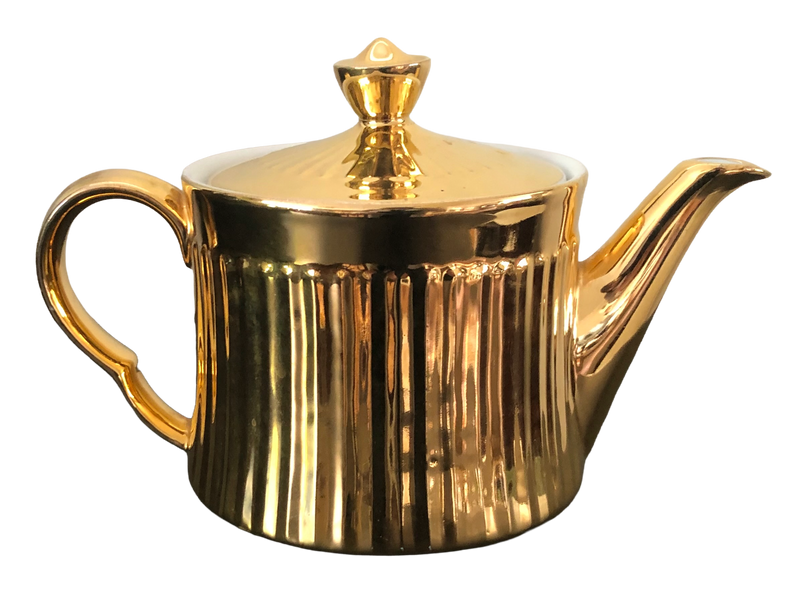
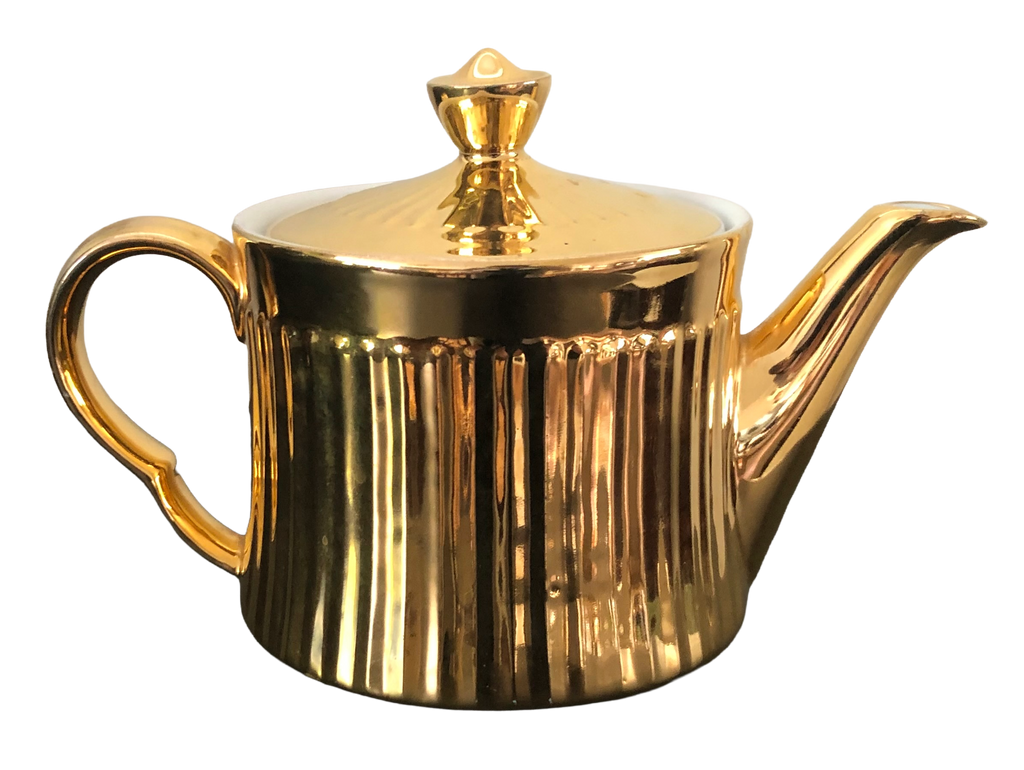
{"id":10941428531359,"title":"Royal Worcester Gold Lustre Fluted Teapot, England, c. 1970s","handle":"royal-worcester-gold-lustre-fluted-1-1-4pt","description":"\u003cp data-pm-slice=\"1 1 []\"\u003e\u003cspan\u003eThis \u003c\/span\u003eRoyal Worcester Gold Lustre Fluted teapot, made in England and dating to around the 1970s, is the smaller 1¼ pint\u003cspan\u003e size. The vertically fluted porcelain body is covered almost entirely in a rich reflective gold lustre, with a white glazed interior and matching lid.\u003c\/span\u003e\u003c\/p\u003e\n\u003cp\u003e\u003cspan\u003eThere is a good bit of Royal Worcester history behind what looks like a very glamorous teapot. The factory had developed a highly fired, heat- and shock-resistant porcelain at government request in \u003c\/span\u003e\u003cstrong\u003e\u003cspan\u003e1914\u003c\/span\u003e\u003c\/strong\u003e\u003cspan\u003e, initially for hospitals and laboratories. That body later found its way into domestic “Fireproof” cookware, and after the war Royal Worcester dressed some of those practical forms in gold and silver lustres. It is a rather wonderful combination of utility and showmanship.\u003c\/span\u003e\u003c\/p\u003e\n\u003cp\u003e\u003cspan\u003eThe fluting works particularly well with the metallic finish. Instead of a flat sheet of gold, the ribs break up the reflections and give the pot much more life as the light moves across it. The curved handle, long spout and pointed finial keep the shape traditional enough to remain recognisably a teapot, while the finish is pure late-mid-century glamour.\u003c\/span\u003e\u003c\/p\u003e\n\u003cp\u003e\u003cspan\u003eAt\u003cstrong\u003e \u003c\/strong\u003e\u003c\/span\u003e1¼ pints\u003cspan\u003e, this is one of the more useful smaller sizes, large enough for tea for two without the bulk of the larger service pots.\u003c\/span\u003e\u003c\/p\u003e\n\u003cp data-pm-slice=\"1 1 []\"\u003e\u003cstrong\u003e\u003cspan\u003eCondition:\u003c\/span\u003e\u003c\/strong\u003e\u003cspan\u003e Excellent vintage condition. The gold lustre remains bright and even, with no obvious signs of regular use. The teapot is complete with its original lid and shows \u003c\/span\u003eno chips, cracks or repairs. It appears to have seen little, if any, actual use.\u003c\/p\u003e\n\u003cp\u003e\u003cstrong\u003e\u003cspan\u003eCollector’s note:\u003c\/span\u003e\u003c\/strong\u003e\u003cspan\u003e What I like about this range is the contrast between its origins and its appearance. Underneath the gold is Royal Worcester’s practical heat-resistant porcelain; on the surface it is unapologetically decorative. It feels very much of the period when everyday tableware was expected to bring a little theatre to the table.\u003c\/span\u003e\u003c\/p\u003e\n\u003cp\u003e\u003cspan\u003e\u003cstrong\u003eWorldwide Shipping:\u003c\/strong\u003e We are always happy to ship worldwide. Your piece will be  packed with great care and sent tracked.\u003c\/span\u003e\u003c\/p\u003e","published_at":"2026-10-27T20:37:02+00:00","created_at":"2026-10-25T22:43:44+00:00","vendor":"Eclectic Design ","type":"Teapot","tags":["1970s","English Porcelain","Gold Lustre","Royal Worcester","Vintage Teapot"],"price":4500,"price_min":4500,"price_max":4500,"available":true,"price_varies":false,"compare_at_price":null,"compare_at_price_min":0,"compare_at_price_max":0,"compare_at_price_varies":false,"variants":[{"id":62896506470559,"title":"Default Title","option1":"Default Title","option2":null,"option3":null,"sku":null,"requires_shipping":true,"taxable":true,"featured_image":null,"available":true,"name":"Royal Worcester Gold Lustre Fluted Teapot, England, c. 1970s","public_title":null,"options":["Default Title"],"price":4500,"weight":2000,"compare_at_price":null,"inventory_quantity":1,"inventory_management":"shopify","inventory_policy":"deny","barcode":null,"requires_selling_plan":false,"selling_plan_allocations":[],"quantity_rule":{"min":1,"max":null,"increment":1}}],"images":["\/\/eclecticdesignlondon.com\/cdn\/shop\/files\/IMG_1135.png?v=1792968072","\/\/eclecticdesignlondon.com\/cdn\/shop\/files\/IMG_0040.png?v=1794155254","\/\/eclecticdesignlondon.com\/cdn\/shop\/files\/IMG_0042.png?v=1794155317","\/\/eclecticdesignlondon.com\/cdn\/shop\/files\/IMG_0035.png?v=1794155194"],"featured_image":"\/\/eclecticdesignlondon.com\/cdn\/shop\/files\/IMG_1135.png?v=1792968072","options":["Title"],"media":[{"alt":"Royal Worcester gold lustre teapot, circa 1970s, with a vertically fluted body, curved handle, long spout and matching lid","id":54633995272351,"position":1,"preview_image":{"aspect_ratio":1.33,"height":1800,"width":2394,"src":"\/\/eclecticdesignlondon.com\/cdn\/shop\/files\/IMG_1135.png?v=1792968072"},"aspect_ratio":1.33,"height":1800,"media_type":"image","src":"\/\/eclecticdesignlondon.com\/cdn\/shop\/files\/IMG_1135.png?v=1792968072","width":2394},{"alt":"Side view of Royal Worcester gold lustre teapot showing the vertically fluted body, long spout, curved handle and matching lid.","id":54654029103263,"position":2,"preview_image":{"aspect_ratio":1.0,"height":2411,"width":2411,"src":"\/\/eclecticdesignlondon.com\/cdn\/shop\/files\/IMG_0040.png?v=1794155254"},"aspect_ratio":1.0,"height":2411,"media_type":"image","src":"\/\/eclecticdesignlondon.com\/cdn\/shop\/files\/IMG_0040.png?v=1794155254","width":2411},{"alt":"Royal Worcester gold lustre teapot viewed from above, showing the reflective lid, pointed finial, spout opening and curved handle.","id":54654029136031,"position":3,"preview_image":{"aspect_ratio":1.19,"height":2709,"width":3224,"src":"\/\/eclecticdesignlondon.com\/cdn\/shop\/files\/IMG_0042.png?v=1794155317"},"aspect_ratio":1.19,"height":2709,"media_type":"image","src":"\/\/eclecticdesignlondon.com\/cdn\/shop\/files\/IMG_0042.png?v=1794155317","width":3224},{"alt":"Underside of the gold lustre teapot showing the Royal Worcester porcelain maker’s mark on the white glazed base.","id":54654029070495,"position":4,"preview_image":{"aspect_ratio":1.0,"height":1132,"width":1132,"src":"\/\/eclecticdesignlondon.com\/cdn\/shop\/files\/IMG_0035.png?v=1794155194"},"aspect_ratio":1.0,"height":1132,"media_type":"image","src":"\/\/eclecticdesignlondon.com\/cdn\/shop\/files\/IMG_0035.png?v=1794155194","width":1132}],"requires_selling_plan":false,"selling_plan_groups":[],"content":"\u003cp data-pm-slice=\"1 1 []\"\u003e\u003cspan\u003eThis \u003c\/span\u003eRoyal Worcester Gold Lustre Fluted teapot, made in England and dating to around the 1970s, is the smaller 1¼ pint\u003cspan\u003e size. The vertically fluted porcelain body is covered almost entirely in a rich reflective gold lustre, with a white glazed interior and matching lid.\u003c\/span\u003e\u003c\/p\u003e\n\u003cp\u003e\u003cspan\u003eThere is a good bit of Royal Worcester history behind what looks like a very glamorous teapot. The factory had developed a highly fired, heat- and shock-resistant porcelain at government request in \u003c\/span\u003e\u003cstrong\u003e\u003cspan\u003e1914\u003c\/span\u003e\u003c\/strong\u003e\u003cspan\u003e, initially for hospitals and laboratories. That body later found its way into domestic “Fireproof” cookware, and after the war Royal Worcester dressed some of those practical forms in gold and silver lustres. It is a rather wonderful combination of utility and showmanship.\u003c\/span\u003e\u003c\/p\u003e\n\u003cp\u003e\u003cspan\u003eThe fluting works particularly well with the metallic finish. Instead of a flat sheet of gold, the ribs break up the reflections and give the pot much more life as the light moves across it. The curved handle, long spout and pointed finial keep the shape traditional enough to remain recognisably a teapot, while the finish is pure late-mid-century glamour.\u003c\/span\u003e\u003c\/p\u003e\n\u003cp\u003e\u003cspan\u003eAt\u003cstrong\u003e \u003c\/strong\u003e\u003c\/span\u003e1¼ pints\u003cspan\u003e, this is one of the more useful smaller sizes, large enough for tea for two without the bulk of the larger service pots.\u003c\/span\u003e\u003c\/p\u003e\n\u003cp data-pm-slice=\"1 1 []\"\u003e\u003cstrong\u003e\u003cspan\u003eCondition:\u003c\/span\u003e\u003c\/strong\u003e\u003cspan\u003e Excellent vintage condition. The gold lustre remains bright and even, with no obvious signs of regular use. The teapot is complete with its original lid and shows \u003c\/span\u003eno chips, cracks or repairs. It appears to have seen little, if any, actual use.\u003c\/p\u003e\n\u003cp\u003e\u003cstrong\u003e\u003cspan\u003eCollector’s note:\u003c\/span\u003e\u003c\/strong\u003e\u003cspan\u003e What I like about this range is the contrast between its origins and its appearance. Underneath the gold is Royal Worcester’s practical heat-resistant porcelain; on the surface it is unapologetically decorative. It feels very much of the period when everyday tableware was expected to bring a little theatre to the table.\u003c\/span\u003e\u003c\/p\u003e\n\u003cp\u003e\u003cspan\u003e\u003cstrong\u003eWorldwide Shipping:\u003c\/strong\u003e We are always happy to ship worldwide. Your piece will be  packed with great care and sent tracked.\u003c\/span\u003e\u003c\/p\u003e"}
Royal Worcester gold lustre teapot, circa 1970s, with a vertically fluted body, curved handle, long spout and matching lid

Royal Worcester Gold Lustre Fluted Teapot, England, c. 1970s

£45.00

This Royal Worcester Gold Lustre Fluted teapot, made in England and dating to around the 1970s, is the smaller 1¼ pint size. The vertically fluted porcelain body is covered almost entirely in a rich reflective gold lustre, with a white glazed interior and matching lid. There is a good bit of Royal Worcester history behind what looks like a very ...
Περισσότερες πληροφορίες
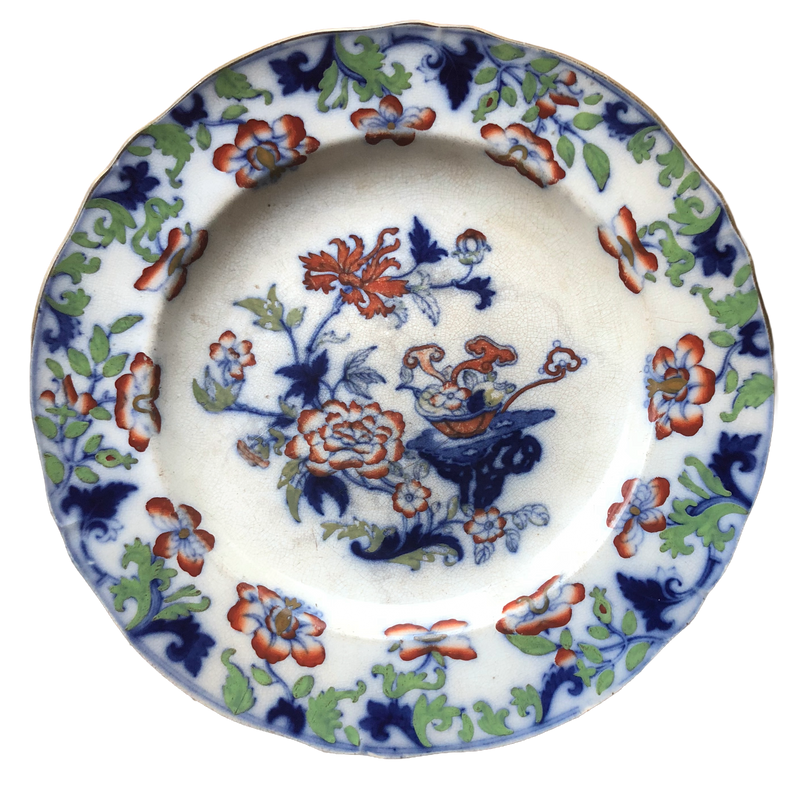
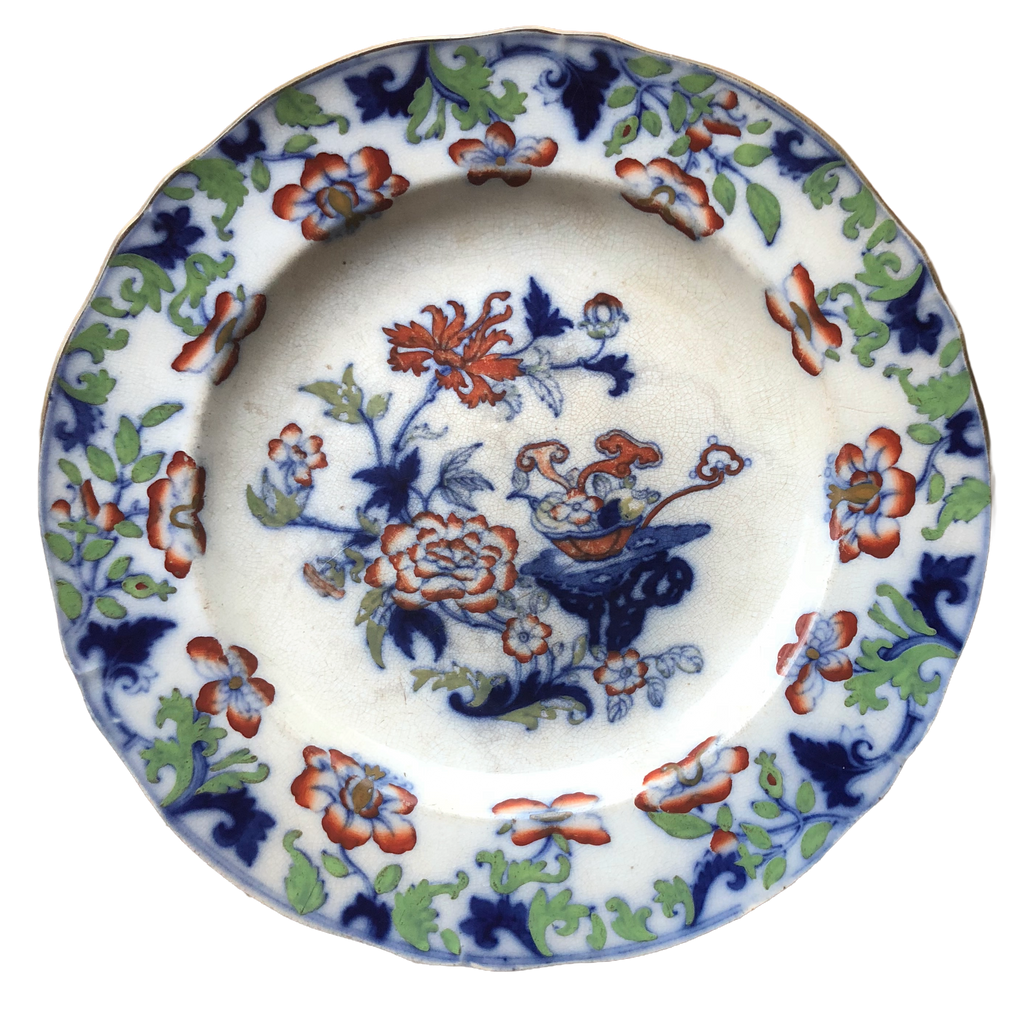
{"id":10942207787167,"title":"Antique Minton \u0026 Hollins TIPPOO Plate, c.1845–1860, BB New Stone, Victorian Staffordshire Transferware","handle":"tippoo-plate","description":"\u003cp data-pm-slice=\"1 1 []\"\u003e\u003cspan\u003eThis early Victorian Minton \u0026amp; Hollins plate, probably dating to around 1845–1860, is decorated in the wonderfully named \u003c\/span\u003e\u003cstrong\u003e\u003cspan\u003eTIPPOO\u003c\/span\u003e\u003c\/strong\u003e\u003cspan\u003e pattern. Made in Staffordshire in Minton’s “BB New Stone” body, it combines deep flowing cobalt blue with hand-applied iron red and fresh green enamels, all set against a softly crazed white ground.\u003c\/span\u003e\u003c\/p\u003e\n\u003cp\u003e\u003cspan\u003eTIPPOO belongs to a group of richly coloured Oriental-inspired patterns produced by Minton in the middle of the 19th century, when British potteries were looking increasingly towards Chinese, Japanese and Indian sources for ideas. Minton produced a number of patterns in this spirit, with names including \u003c\/span\u003e\u003cem\u003e\u003cspan\u003ePoonah\u003c\/span\u003e\u003c\/em\u003e\u003cspan\u003e, \u003c\/span\u003e\u003cem\u003e\u003cspan\u003eBombay Japan\u003c\/span\u003e\u003c\/em\u003e\u003cspan\u003e and \u003c\/span\u003e\u003cem\u003e\u003cspan\u003eAmherst Japan\u003c\/span\u003e\u003c\/em\u003e\u003cspan\u003e. TIPPOO shares the same love of dense floral decoration, strong colour and an almost exotic abundance of ornament.\u003c\/span\u003e\u003c\/p\u003e\n\u003cp\u003e\u003cspan\u003eThe name is particularly interesting. “Tippoo” was the spelling commonly used in Britain for \u003c\/span\u003e\u003cstrong\u003e\u003cspan\u003eTipu Sultan of Mysore\u003c\/span\u003e\u003c\/strong\u003e\u003cspan\u003e, who remained a famous and rather romanticised figure in 19th-century British culture. It is very tempting to read the pattern name as a reference to him, especially alongside Minton’s other Indian-inspired pattern names, although I have not found a surviving factory record that actually confirms why Minton chose the name. For that reason I would treat the connection as very likely rather than completely proven.\u003c\/span\u003e\u003c\/p\u003e\n\u003cp\u003e\u003cspan\u003eWhat I like here is how far removed this is from the restrained idea we sometimes have of Victorian tableware. The border is almost completely filled with scrolling green foliage, blue leaves and red-edged flowers, while the centre has its own wonderfully eccentric arrangement of flowers and a small ornamental vessel. There is a real looseness to the colouring too. The enamels do not sit with machine-like precision over the blue printing, which gives the whole plate a much more lively, handmade quality.\u003c\/span\u003e\u003c\/p\u003e\n\u003cp\u003e\u003cspan\u003eThe reverse is particularly useful. It carries the blue printed \u003c\/span\u003e\u003cstrong\u003e\u003cspan\u003eTIPPOO\u003c\/span\u003e\u003c\/strong\u003e\u003cspan\u003e pattern mark together with the impressed \u003c\/span\u003e\u003cstrong\u003e\u003cspan\u003e“BB \/ NEW STONE”\u003c\/span\u003e\u003c\/strong\u003e\u003cspan\u003e mark. BB stood for \u003c\/span\u003e\u003cstrong\u003e\u003cspan\u003e“Best Body”\u003c\/span\u003e\u003c\/strong\u003e\u003cspan\u003e, one of Minton’s earthenware body designations. There is also a painted red \u003c\/span\u003e\u003cstrong\u003e\u003cspan\u003e6096\u003c\/span\u003e\u003c\/strong\u003e\u003cspan\u003e, very likely a factory pattern or decorating reference, although I have not found a surviving published register that allows me to identify that number with complete certainty.\u003c\/span\u003e\u003c\/p\u003e\n\u003cp\u003e\u003cstrong\u003eDimensions Approximate: \u003c\/strong\u003eDiameter 9 1\/2\"(22cm)\u003c\/p\u003e\n\u003cp\u003e\u003cstrong\u003e\u003cspan\u003eCondition:\u003c\/span\u003e\u003c\/strong\u003e\u003cspan\u003e Good antique condition for a piece approaching 170 years old. There is extensive fine crazing to the glaze, entirely consistent with age and clearly visible in the photographs. There are small areas of rubbing and minor age-related wear to the decoration, but no obvious major chips or cracks visible in the photographs.\u003c\/span\u003e\u003c\/p\u003e\n\u003cp\u003e\u003cstrong\u003e\u003cspan\u003eCollector’s note:\u003c\/span\u003e\u003c\/strong\u003e\u003cspan\u003e What makes this plate interesting is not simply that it is early Minton, but that it captures the Victorian fascination with an imagined “Orient”. Pattern names such as TIPPOO turned historical figures and distant places into part of the language of the Victorian dining table. Today that makes the plate both a decorative object and a small piece of British social and design history.\u003c\/span\u003e\u003c\/p\u003e\n\u003cp\u003e\u003cstrong\u003e\u003cspan\u003eWorldwide Shipping:\u003c\/span\u003e\u003c\/strong\u003e\u003cspan\u003e We are always happy to ship worldwide. Your piece will be packed with great care and sent tracked.\u003c\/span\u003e\u003c\/p\u003e","published_at":"2026-10-31T21:32:37+00:00","created_at":"2026-10-31T20:05:24+00:00","vendor":"Eclectic Design ","type":"Antique Plate","tags":["Antique Plate","Minton \u0026 Hollins","Staffordshire Transferware","TIPPOO","Victorian"],"price":4200,"price_min":4200,"price_max":4200,"available":true,"price_varies":false,"compare_at_price":null,"compare_at_price_min":0,"compare_at_price_max":0,"compare_at_price_varies":false,"variants":[{"id":62900953448607,"title":"Default Title","option1":"Default Title","option2":null,"option3":null,"sku":null,"requires_shipping":true,"taxable":true,"featured_image":null,"available":true,"name":"Antique Minton \u0026 Hollins TIPPOO Plate, c.1845–1860, BB New Stone, Victorian Staffordshire Transferware","public_title":null,"options":["Default Title"],"price":4200,"weight":1000,"compare_at_price":null,"inventory_quantity":1,"inventory_management":"shopify","inventory_policy":"deny","barcode":null,"requires_selling_plan":false,"selling_plan_allocations":[],"quantity_rule":{"min":1,"max":null,"increment":1}}],"images":["\/\/eclecticdesignlondon.com\/cdn\/shop\/files\/IMG_0992.png?v=1793481707","\/\/eclecticdesignlondon.com\/cdn\/shop\/files\/IMG_0994.png?v=1793481618","\/\/eclecticdesignlondon.com\/cdn\/shop\/files\/IMG_0995.jpg?v=1793477072","\/\/eclecticdesignlondon.com\/cdn\/shop\/files\/IMG_0996.png?v=1793481615","\/\/eclecticdesignlondon.com\/cdn\/shop\/files\/IMG_0993.jpg?v=1793481783","\/\/eclecticdesignlondon.com\/cdn\/shop\/files\/IMG_1001.jpg?v=1793477072","\/\/eclecticdesignlondon.com\/cdn\/shop\/files\/IMG_0997.png?v=1793481829","\/\/eclecticdesignlondon.com\/cdn\/shop\/files\/IMG_0999.jpg?v=1793477072","\/\/eclecticdesignlondon.com\/cdn\/shop\/files\/IMG_0998.jpg?v=1793477072","\/\/eclecticdesignlondon.com\/cdn\/shop\/files\/IMG_0990.jpg?v=1793481873"],"featured_image":"\/\/eclecticdesignlondon.com\/cdn\/shop\/files\/IMG_0992.png?v=1793481707","options":["Title"],"media":[{"alt":"Antique Minton \u0026 Hollins TIPPOO plate with cobalt blue foliage, iron-red flowers and green enamel decoration, circa 1845–1860.\n","id":54643966378143,"position":1,"preview_image":{"aspect_ratio":1.0,"height":2802,"width":2802,"src":"\/\/eclecticdesignlondon.com\/cdn\/shop\/files\/IMG_0992.png?v=1793481707"},"aspect_ratio":1.0,"height":2802,"media_type":"image","src":"\/\/eclecticdesignlondon.com\/cdn\/shop\/files\/IMG_0992.png?v=1793481707","width":2802},{"alt":"Close-up of the Minton TIPPOO plate’s floral border, showing iron-red petals, green leaves, cobalt blue printing and fine glaze crazing.","id":54643966607519,"position":2,"preview_image":{"aspect_ratio":1.0,"height":3024,"width":3024,"src":"\/\/eclecticdesignlondon.com\/cdn\/shop\/files\/IMG_0994.png?v=1793481618"},"aspect_ratio":1.0,"height":3024,"media_type":"image","src":"\/\/eclecticdesignlondon.com\/cdn\/shop\/files\/IMG_0994.png?v=1793481618","width":3024},{"alt":"Detail of flowers and an ornamental vessel in the centre of the Minton TIPPOO plate, showing coloured enamels and crazed glaze.","id":54643954155679,"position":3,"preview_image":{"aspect_ratio":1.0,"height":3024,"width":3024,"src":"\/\/eclecticdesignlondon.com\/cdn\/shop\/files\/IMG_0995.jpg?v=1793477072"},"aspect_ratio":1.0,"height":3024,"media_type":"image","src":"\/\/eclecticdesignlondon.com\/cdn\/shop\/files\/IMG_0995.jpg?v=1793477072","width":3024},{"alt":"Angled detail of the Minton TIPPOO plate’s rim, showing its shaped edge and blue, green and iron-red floral decoration.","id":54643966640287,"position":4,"preview_image":{"aspect_ratio":1.0,"height":3024,"width":3024,"src":"\/\/eclecticdesignlondon.com\/cdn\/shop\/files\/IMG_0996.png?v=1793481615"},"aspect_ratio":1.0,"height":3024,"media_type":"image","src":"\/\/eclecticdesignlondon.com\/cdn\/shop\/files\/IMG_0996.png?v=1793481615","width":3024},{"alt":"Full front view of the antique Minton \u0026 Hollins TIPPOO plate on a wooden surface, with colourful floral decoration and a shaped rim.\n","id":54643954221215,"position":5,"preview_image":{"aspect_ratio":1.0,"height":2646,"width":2646,"src":"\/\/eclecticdesignlondon.com\/cdn\/shop\/files\/IMG_0993.jpg?v=1793481783"},"aspect_ratio":1.0,"height":2646,"media_type":"image","src":"\/\/eclecticdesignlondon.com\/cdn\/shop\/files\/IMG_0993.jpg?v=1793481783","width":2646},{"alt":"Close-up of the blue printed TIPPOO pattern mark and hand-painted red number 6096 on the reverse of the Minton ","id":54643953991839,"position":6,"preview_image":{"aspect_ratio":1.0,"height":3024,"width":3024,"src":"\/\/eclecticdesignlondon.com\/cdn\/shop\/files\/IMG_1001.jpg?v=1793477072"},"aspect_ratio":1.0,"height":3024,"media_type":"image","src":"\/\/eclecticdesignlondon.com\/cdn\/shop\/files\/IMG_1001.jpg?v=1793477072","width":3024},{"alt":"Reverse of the antique Minton TIPPOO plate, showing the raised foot ring, blue printed pattern mark and impressed body mark.","id":54643966673055,"position":7,"preview_image":{"aspect_ratio":1.0,"height":2857,"width":2857,"src":"\/\/eclecticdesignlondon.com\/cdn\/shop\/files\/IMG_0997.png?v=1793481829"},"aspect_ratio":1.0,"height":2857,"media_type":"image","src":"\/\/eclecticdesignlondon.com\/cdn\/shop\/files\/IMG_0997.png?v=1793481829","width":2857},{"alt":"Minton plate reverse with blue floral TIPPOO mark, red painted number 6096 and impressed lettering above.","id":54643954024607,"position":8,"preview_image":{"aspect_ratio":1.0,"height":3024,"width":3024,"src":"\/\/eclecticdesignlondon.com\/cdn\/shop\/files\/IMG_0999.jpg?v=1793477072"},"aspect_ratio":1.0,"height":3024,"media_type":"image","src":"\/\/eclecticdesignlondon.com\/cdn\/shop\/files\/IMG_0999.jpg?v=1793477072","width":3024},{"alt":"Detail of the Minton TIPPOO plate’s underside, showing printed and impressed marks BB NEW STONE beneath a finely crazed glaze.","id":54643954057375,"position":9,"preview_image":{"aspect_ratio":1.0,"height":3024,"width":3024,"src":"\/\/eclecticdesignlondon.com\/cdn\/shop\/files\/IMG_0998.jpg?v=1793477072"},"aspect_ratio":1.0,"height":3024,"media_type":"image","src":"\/\/eclecticdesignlondon.com\/cdn\/shop\/files\/IMG_0998.jpg?v=1793477072","width":3024},{"alt":"Close-up of the impressed BB NEW STONE mark on the Minton plate, with part of the blue TIPPOO mark above.","id":54643954286751,"position":10,"preview_image":{"aspect_ratio":1.0,"height":3024,"width":3024,"src":"\/\/eclecticdesignlondon.com\/cdn\/shop\/files\/IMG_0990.jpg?v=1793481873"},"aspect_ratio":1.0,"height":3024,"media_type":"image","src":"\/\/eclecticdesignlondon.com\/cdn\/shop\/files\/IMG_0990.jpg?v=1793481873","width":3024}],"requires_selling_plan":false,"selling_plan_groups":[],"content":"\u003cp data-pm-slice=\"1 1 []\"\u003e\u003cspan\u003eThis early Victorian Minton \u0026amp; Hollins plate, probably dating to around 1845–1860, is decorated in the wonderfully named \u003c\/span\u003e\u003cstrong\u003e\u003cspan\u003eTIPPOO\u003c\/span\u003e\u003c\/strong\u003e\u003cspan\u003e pattern. Made in Staffordshire in Minton’s “BB New Stone” body, it combines deep flowing cobalt blue with hand-applied iron red and fresh green enamels, all set against a softly crazed white ground.\u003c\/span\u003e\u003c\/p\u003e\n\u003cp\u003e\u003cspan\u003eTIPPOO belongs to a group of richly coloured Oriental-inspired patterns produced by Minton in the middle of the 19th century, when British potteries were looking increasingly towards Chinese, Japanese and Indian sources for ideas. Minton produced a number of patterns in this spirit, with names including \u003c\/span\u003e\u003cem\u003e\u003cspan\u003ePoonah\u003c\/span\u003e\u003c\/em\u003e\u003cspan\u003e, \u003c\/span\u003e\u003cem\u003e\u003cspan\u003eBombay Japan\u003c\/span\u003e\u003c\/em\u003e\u003cspan\u003e and \u003c\/span\u003e\u003cem\u003e\u003cspan\u003eAmherst Japan\u003c\/span\u003e\u003c\/em\u003e\u003cspan\u003e. TIPPOO shares the same love of dense floral decoration, strong colour and an almost exotic abundance of ornament.\u003c\/span\u003e\u003c\/p\u003e\n\u003cp\u003e\u003cspan\u003eThe name is particularly interesting. “Tippoo” was the spelling commonly used in Britain for \u003c\/span\u003e\u003cstrong\u003e\u003cspan\u003eTipu Sultan of Mysore\u003c\/span\u003e\u003c\/strong\u003e\u003cspan\u003e, who remained a famous and rather romanticised figure in 19th-century British culture. It is very tempting to read the pattern name as a reference to him, especially alongside Minton’s other Indian-inspired pattern names, although I have not found a surviving factory record that actually confirms why Minton chose the name. For that reason I would treat the connection as very likely rather than completely proven.\u003c\/span\u003e\u003c\/p\u003e\n\u003cp\u003e\u003cspan\u003eWhat I like here is how far removed this is from the restrained idea we sometimes have of Victorian tableware. The border is almost completely filled with scrolling green foliage, blue leaves and red-edged flowers, while the centre has its own wonderfully eccentric arrangement of flowers and a small ornamental vessel. There is a real looseness to the colouring too. The enamels do not sit with machine-like precision over the blue printing, which gives the whole plate a much more lively, handmade quality.\u003c\/span\u003e\u003c\/p\u003e\n\u003cp\u003e\u003cspan\u003eThe reverse is particularly useful. It carries the blue printed \u003c\/span\u003e\u003cstrong\u003e\u003cspan\u003eTIPPOO\u003c\/span\u003e\u003c\/strong\u003e\u003cspan\u003e pattern mark together with the impressed \u003c\/span\u003e\u003cstrong\u003e\u003cspan\u003e“BB \/ NEW STONE”\u003c\/span\u003e\u003c\/strong\u003e\u003cspan\u003e mark. BB stood for \u003c\/span\u003e\u003cstrong\u003e\u003cspan\u003e“Best Body”\u003c\/span\u003e\u003c\/strong\u003e\u003cspan\u003e, one of Minton’s earthenware body designations. There is also a painted red \u003c\/span\u003e\u003cstrong\u003e\u003cspan\u003e6096\u003c\/span\u003e\u003c\/strong\u003e\u003cspan\u003e, very likely a factory pattern or decorating reference, although I have not found a surviving published register that allows me to identify that number with complete certainty.\u003c\/span\u003e\u003c\/p\u003e\n\u003cp\u003e\u003cstrong\u003eDimensions Approximate: \u003c\/strong\u003eDiameter 9 1\/2\"(22cm)\u003c\/p\u003e\n\u003cp\u003e\u003cstrong\u003e\u003cspan\u003eCondition:\u003c\/span\u003e\u003c\/strong\u003e\u003cspan\u003e Good antique condition for a piece approaching 170 years old. There is extensive fine crazing to the glaze, entirely consistent with age and clearly visible in the photographs. There are small areas of rubbing and minor age-related wear to the decoration, but no obvious major chips or cracks visible in the photographs.\u003c\/span\u003e\u003c\/p\u003e\n\u003cp\u003e\u003cstrong\u003e\u003cspan\u003eCollector’s note:\u003c\/span\u003e\u003c\/strong\u003e\u003cspan\u003e What makes this plate interesting is not simply that it is early Minton, but that it captures the Victorian fascination with an imagined “Orient”. Pattern names such as TIPPOO turned historical figures and distant places into part of the language of the Victorian dining table. Today that makes the plate both a decorative object and a small piece of British social and design history.\u003c\/span\u003e\u003c\/p\u003e\n\u003cp\u003e\u003cstrong\u003e\u003cspan\u003eWorldwide Shipping:\u003c\/span\u003e\u003c\/strong\u003e\u003cspan\u003e We are always happy to ship worldwide. Your piece will be packed with great care and sent tracked.\u003c\/span\u003e\u003c\/p\u003e"}
Antique Minton & Hollins TIPPOO plate with cobalt blue foliage, iron-red flowers and green enamel decoration, circa 1845–1860.

Antique Minton & Hollins TIPPOO Plate, c.1845–1860, BB New Stone, Victorian Staffordshire Transferware

£42.00

This early Victorian Minton & Hollins plate, probably dating to around 1845–1860, is decorated in the wonderfully named TIPPOO pattern. Made in Staffordshire in Minton’s “BB New Stone” body, it combines deep flowing cobalt blue with hand-applied iron red and fresh green enamels, all set against a softly crazed white ground. TIPPOO belongs to...
Περισσότερες πληροφορίες
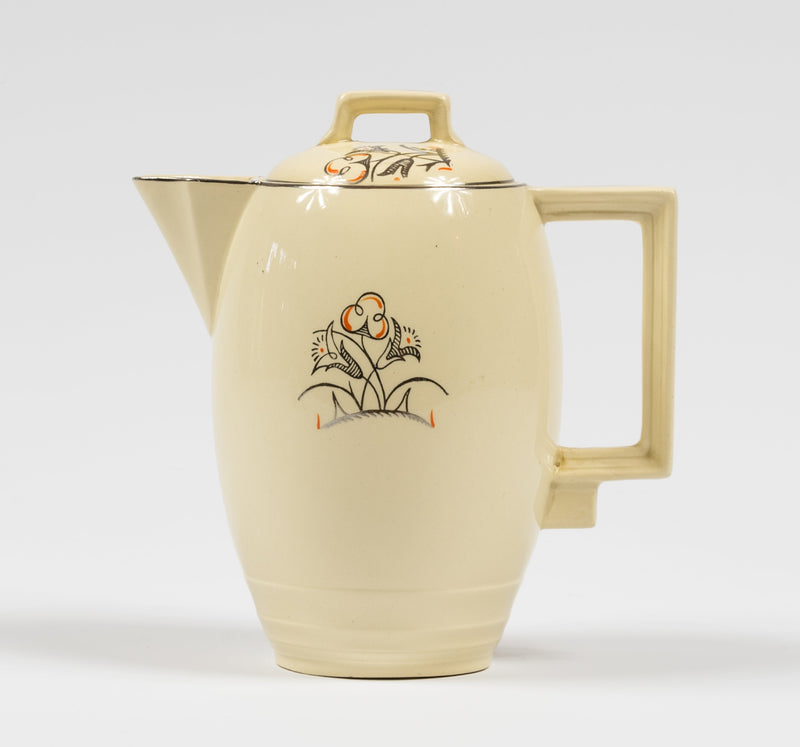
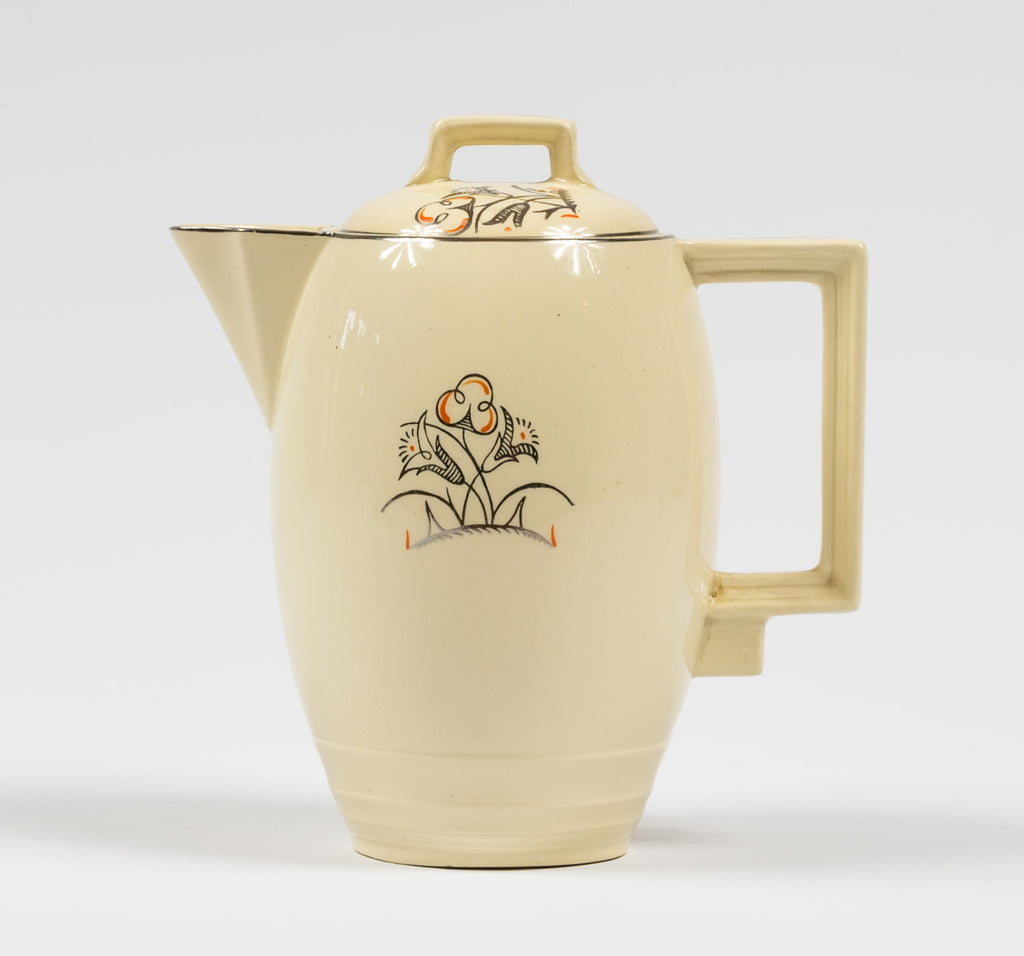
{"id":10931428130975,"title":"1930s Johnson Brothers Art Deco Coffee Pot, Victorian Ware, England","handle":"teapot-2","description":"\u003cp data-pm-slice=\"1 1 []\"\u003e\u003cspan\u003eThis lovely Art Deco coffee pot by Johnson Brothers of Staffordshire, dating to the 1930s, is made in the company's cream-coloured Victorian ware. It has a wonderfully architectural shape, with a tall, gently tapering body, sharply angular handle, straight-sided spout and matching lid with a rectangular finial. The pale cream glaze is decorated with stylised flowers in black and orange, with delicate grey detailing and a narrow metallic rim.\u003c\/span\u003e\u003c\/p\u003e\n\u003cp\u003e\u003cspan\u003eJohnson Brothers was established in Hanley, Staffordshire, in 1883 and became one of Britain's most successful manufacturers of affordable domestic tableware. During the interwar years, British potteries increasingly embraced the cleaner lines and geometric forms of Art Deco, moving away from the more elaborate decoration of the Edwardian period. This coffee pot is a particularly attractive example of that change, combining a traditional floral motif with a thoroughly modern shape.\u003c\/span\u003e\u003c\/p\u003e\n\u003cp\u003e\u003cspan\u003eWhat I like here is the contrast between the rather delicate decoration and the strong geometry of the pot itself. The handle is almost square, the lid has a matching rectangular grip, and even the spout feels deliberately architectural. Yet the little flowers, drawn with such economical lines and just a few touches of orange, soften the whole design beautifully. It has that distinctly 1930s balance between something decorative and something quite practical.\u003c\/span\u003e\u003c\/p\u003e\n\u003cp\u003e\u003cspan\u003eInterestingly, the same floral decoration can be found on another Johnson Brothers coffee service, but the shapes are quite different. That service has curved handles, a rounded lid finial and a more conventional sweeping spout. This pot, with its distinctive rectangular handle, angular spout and geometric lid grip, clearly does not belong to that particular service. It represents a different shape, although its exact factory shape name has not yet been established. It is an interesting reminder that British potteries sometimes used the same decoration across very different designs.\u003c\/span\u003e\u003c\/p\u003e\n\u003cp\u003e\u003cspan\u003eThe underside carries the green printed \u003c\/span\u003e\u003cstrong\u003e\u003cspan\u003e\"Victorian, Johnson Bros, England\"\u003c\/span\u003e\u003c\/strong\u003e\u003cspan\u003e backstamp beneath a crown. Interestingly, Victorian was a name used by Johnson Brothers for its cream-coloured ceramic body, rather than necessarily identifying the floral decoration. Despite the name, this is not Victorian-period pottery, but an example of British tableware from the Art Deco era.\u003c\/span\u003e\u003c\/p\u003e\n\u003cp\u003e\u003cstrong\u003e\u003cspan\u003eCondition:\u003c\/span\u003e\u003c\/strong\u003e\u003cspan\u003e Good vintage condition with some age-related signs of use. No chips or cracks.\u003c\/span\u003e\u003c\/p\u003e\n\u003cp\u003e\u003cstrong\u003e\u003cspan\u003eCollector's note:\u003c\/span\u003e\u003c\/strong\u003e\u003cspan\u003e There is something particularly appealing about everyday British Art Deco pottery. Not all modern design of the 1930s was expensive or intended for fashionable interiors. Manufacturers such as Johnson Brothers brought the new geometric style into ordinary homes through affordable tea and coffee services. This particular pot stands out for its unusually strong architectural lines, especially the rectangular handle and matching lid grip. The fact that the same floral decoration appears on a completely different coffee service makes the contrast between the two designs all the more interesting.\u003c\/span\u003e\u003c\/p\u003e\n\u003cp\u003e\u003cstrong\u003e\u003cspan\u003eWorldwide Shipping:\u003c\/span\u003e\u003c\/strong\u003e\u003cspan\u003e We are always happy to ship worldwide. Your piece will be packed with great care and sent tracked.\u003c\/span\u003e\u003c\/p\u003e","published_at":"2026-11-04T12:56:26+00:00","created_at":"2026-08-30T11:11:45+01:00","vendor":"Eclectic Design ","type":"Teapot","tags":["1930s","Art Deco","Coffee Pot","Johnson Brothers","Victorian Ware"],"price":4500,"price_min":4500,"price_max":4500,"available":true,"price_varies":false,"compare_at_price":null,"compare_at_price_min":0,"compare_at_price_max":0,"compare_at_price_varies":false,"variants":[{"id":62856456306847,"title":"Default Title","option1":"Default Title","option2":null,"option3":null,"sku":null,"requires_shipping":true,"taxable":true,"featured_image":null,"available":true,"name":"1930s Johnson Brothers Art Deco Coffee Pot, Victorian Ware, England","public_title":null,"options":["Default Title"],"price":4500,"weight":1500,"compare_at_price":null,"inventory_quantity":1,"inventory_management":"shopify","inventory_policy":"deny","barcode":null,"requires_selling_plan":false,"selling_plan_allocations":[],"quantity_rule":{"min":1,"max":null,"increment":1}}],"images":["\/\/eclecticdesignlondon.com\/cdn\/shop\/files\/DSC5940_593ece69-2dd2-4fb2-a293-f4ef38cc7f7a.jpg?v=1793796507","\/\/eclecticdesignlondon.com\/cdn\/shop\/files\/DSC6518_46994ddf-b9d9-4dc3-918d-cb5ce23a16c3.jpg?v=1793796785"],"featured_image":"\/\/eclecticdesignlondon.com\/cdn\/shop\/files\/DSC5940_593ece69-2dd2-4fb2-a293-f4ef38cc7f7a.jpg?v=1793796507","options":["Title"],"media":[{"alt":"1930s Johnson Brothers Art Deco cream coffee pot with black and orange floral decoration, angular handle and matching lid.","id":54551989485727,"position":1,"preview_image":{"aspect_ratio":1.071,"height":3414,"width":3658,"src":"\/\/eclecticdesignlondon.com\/cdn\/shop\/files\/DSC5940_593ece69-2dd2-4fb2-a293-f4ef38cc7f7a.jpg?v=1793796507"},"aspect_ratio":1.071,"height":3414,"media_type":"image","src":"\/\/eclecticdesignlondon.com\/cdn\/shop\/files\/DSC5940_593ece69-2dd2-4fb2-a293-f4ef38cc7f7a.jpg?v=1793796507","width":3658},{"alt":"Base of the Art Deco coffee pot showing the green crowned Victorian Ware Johnson Bros England backstamp and wear around the foot ring.","id":54648634933407,"position":2,"preview_image":{"aspect_ratio":1.084,"height":4007,"width":4345,"src":"\/\/eclecticdesignlondon.com\/cdn\/shop\/files\/DSC6518_46994ddf-b9d9-4dc3-918d-cb5ce23a16c3.jpg?v=1793796785"},"aspect_ratio":1.084,"height":4007,"media_type":"image","src":"\/\/eclecticdesignlondon.com\/cdn\/shop\/files\/DSC6518_46994ddf-b9d9-4dc3-918d-cb5ce23a16c3.jpg?v=1793796785","width":4345}],"requires_selling_plan":false,"selling_plan_groups":[],"content":"\u003cp data-pm-slice=\"1 1 []\"\u003e\u003cspan\u003eThis lovely Art Deco coffee pot by Johnson Brothers of Staffordshire, dating to the 1930s, is made in the company's cream-coloured Victorian ware. It has a wonderfully architectural shape, with a tall, gently tapering body, sharply angular handle, straight-sided spout and matching lid with a rectangular finial. The pale cream glaze is decorated with stylised flowers in black and orange, with delicate grey detailing and a narrow metallic rim.\u003c\/span\u003e\u003c\/p\u003e\n\u003cp\u003e\u003cspan\u003eJohnson Brothers was established in Hanley, Staffordshire, in 1883 and became one of Britain's most successful manufacturers of affordable domestic tableware. During the interwar years, British potteries increasingly embraced the cleaner lines and geometric forms of Art Deco, moving away from the more elaborate decoration of the Edwardian period. This coffee pot is a particularly attractive example of that change, combining a traditional floral motif with a thoroughly modern shape.\u003c\/span\u003e\u003c\/p\u003e\n\u003cp\u003e\u003cspan\u003eWhat I like here is the contrast between the rather delicate decoration and the strong geometry of the pot itself. The handle is almost square, the lid has a matching rectangular grip, and even the spout feels deliberately architectural. Yet the little flowers, drawn with such economical lines and just a few touches of orange, soften the whole design beautifully. It has that distinctly 1930s balance between something decorative and something quite practical.\u003c\/span\u003e\u003c\/p\u003e\n\u003cp\u003e\u003cspan\u003eInterestingly, the same floral decoration can be found on another Johnson Brothers coffee service, but the shapes are quite different. That service has curved handles, a rounded lid finial and a more conventional sweeping spout. This pot, with its distinctive rectangular handle, angular spout and geometric lid grip, clearly does not belong to that particular service. It represents a different shape, although its exact factory shape name has not yet been established. It is an interesting reminder that British potteries sometimes used the same decoration across very different designs.\u003c\/span\u003e\u003c\/p\u003e\n\u003cp\u003e\u003cspan\u003eThe underside carries the green printed \u003c\/span\u003e\u003cstrong\u003e\u003cspan\u003e\"Victorian, Johnson Bros, England\"\u003c\/span\u003e\u003c\/strong\u003e\u003cspan\u003e backstamp beneath a crown. Interestingly, Victorian was a name used by Johnson Brothers for its cream-coloured ceramic body, rather than necessarily identifying the floral decoration. Despite the name, this is not Victorian-period pottery, but an example of British tableware from the Art Deco era.\u003c\/span\u003e\u003c\/p\u003e\n\u003cp\u003e\u003cstrong\u003e\u003cspan\u003eCondition:\u003c\/span\u003e\u003c\/strong\u003e\u003cspan\u003e Good vintage condition with some age-related signs of use. No chips or cracks.\u003c\/span\u003e\u003c\/p\u003e\n\u003cp\u003e\u003cstrong\u003e\u003cspan\u003eCollector's note:\u003c\/span\u003e\u003c\/strong\u003e\u003cspan\u003e There is something particularly appealing about everyday British Art Deco pottery. Not all modern design of the 1930s was expensive or intended for fashionable interiors. Manufacturers such as Johnson Brothers brought the new geometric style into ordinary homes through affordable tea and coffee services. This particular pot stands out for its unusually strong architectural lines, especially the rectangular handle and matching lid grip. The fact that the same floral decoration appears on a completely different coffee service makes the contrast between the two designs all the more interesting.\u003c\/span\u003e\u003c\/p\u003e\n\u003cp\u003e\u003cstrong\u003e\u003cspan\u003eWorldwide Shipping:\u003c\/span\u003e\u003c\/strong\u003e\u003cspan\u003e We are always happy to ship worldwide. Your piece will be packed with great care and sent tracked.\u003c\/span\u003e\u003c\/p\u003e"}
1930s Johnson Brothers Art Deco cream coffee pot with black and orange floral decoration, angular handle and matching lid.

1930s Johnson Brothers Art Deco Coffee Pot, Victorian Ware, England

£45.00

This lovely Art Deco coffee pot by Johnson Brothers of Staffordshire, dating to the 1930s, is made in the company's cream-coloured Victorian ware. It has a wonderfully architectural shape, with a tall, gently tapering body, sharply angular handle, straight-sided spout and matching lid with a rectangular finial. The pale cream glaze is decorated ...
Περισσότερες πληροφορίες
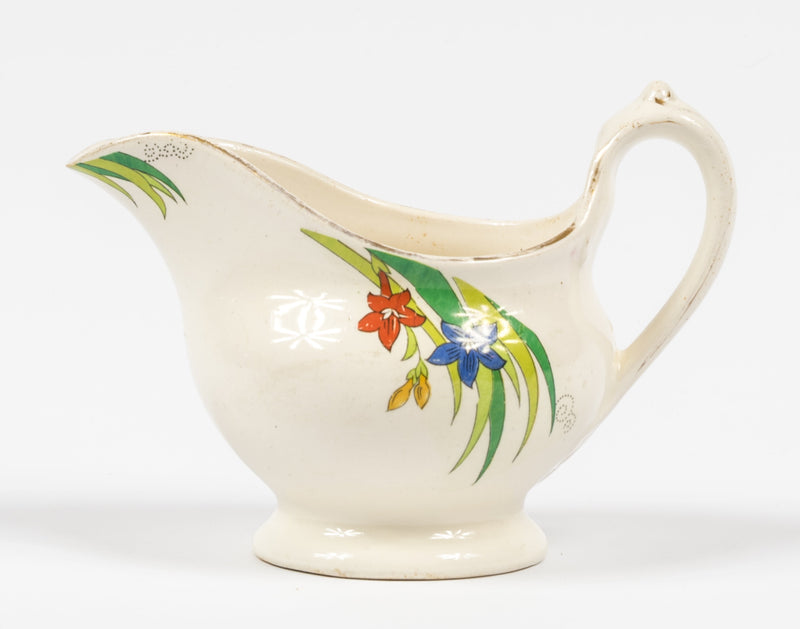
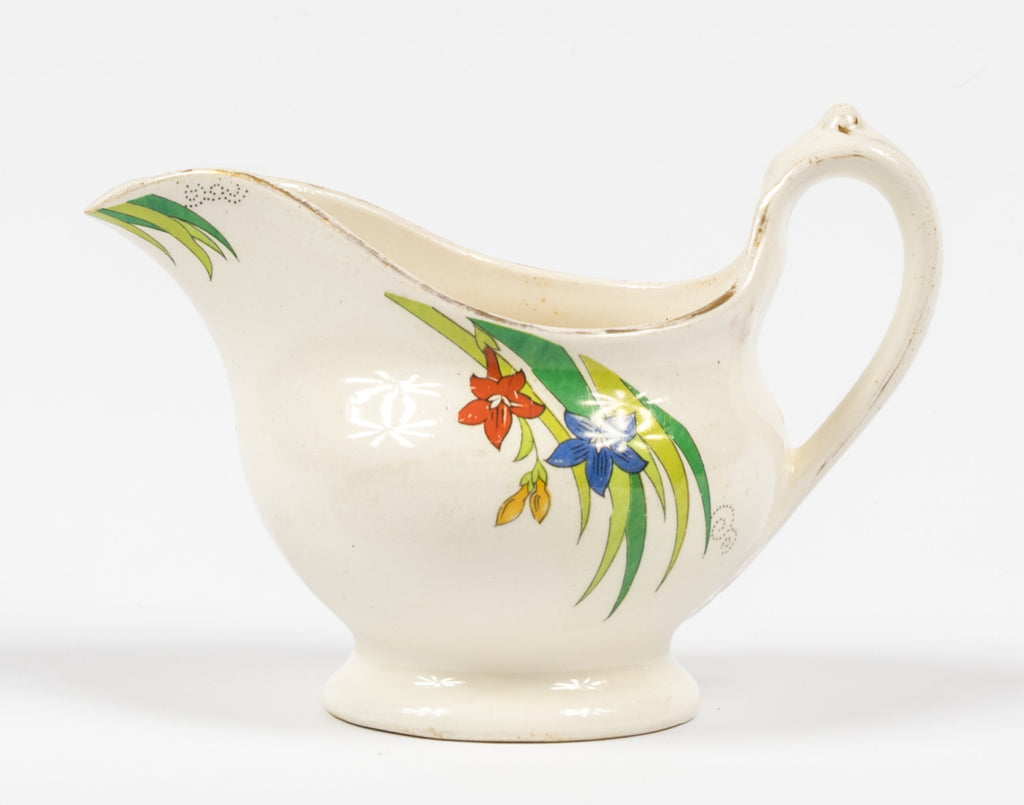
{"id":10931429277855,"title":"Art Deco Keeling Losol Ware Floral Jug, 1930s","handle":"jug2","description":"\u003cp data-pm-slice=\"1 1 []\"\u003e\u003cspan\u003eThis lovely Art Deco sauce jug by Keeling \u0026amp; Co. of Burslem, Staffordshire, probably dates to the late 1920s or 1930s. Made in the company's well-known Losol Ware, it has a wonderfully flowing shape, with a long, pointed pouring lip, elegant raised handle and rounded body decorated with brightly coloured stylised flowers. The warm cream glaze provides a lovely background for the vivid red and blue blossoms, fresh green and yellow leaves and delicate black detailing.\u003c\/span\u003e\u003c\/p\u003e\n\u003cp\u003e\u003cspan\u003eKeeling \u0026amp; Co. operated at the Dale Hall Works in Burslem from 1886 until 1936, introducing the Losol Ware name around 1912. Interestingly, Losol was a contraction of \"low solubility\", referring to a specially developed glaze intended to reduce the risks associated with soluble lead in pottery production. This was a period when the health of pottery workers was becoming an increasingly important concern, and manufacturers were beginning to promote improvements in their production methods.\u003c\/span\u003e\u003c\/p\u003e\n\u003cp\u003e\u003cspan\u003eThe factory became particularly associated with brightly coloured decorative earthenware, producing everything from traditional transfer-printed designs to the more modern floral and fruit patterns fashionable during the Art Deco years. The designer Charles Wright, who had previously worked for Maling in Newcastle upon Tyne, was an important influence on this direction, although the designer of this particular pattern is not known.\u003c\/span\u003e\u003c\/p\u003e\n\u003cp\u003e\u003cspan\u003eWhat I particularly like here is the contrast between the flowing shape of the jug and the almost graphic quality of the decoration. The flowers are reduced to simple blocks of red and blue, while the long green leaves follow the curve of the body beautifully. There is something quite modern about the whole arrangement, especially the way the decoration has been left relatively sparse rather than covering every available surface. The exaggerated spout is particularly appealing and gives the jug a wonderfully distinctive silhouette.\u003c\/span\u003e\u003c\/p\u003e\n\u003cp\u003e\u003cspan\u003eThe underside carries the printed \u003c\/span\u003e\u003cstrong\u003e\u003cspan\u003eLosol Ware, Keeling \u0026amp; Co. Ltd, Burslem, Made in England\u003c\/span\u003e\u003c\/strong\u003e\u003cspan\u003e backstamp, together with the hand-painted number \u003c\/span\u003e\u003cstrong\u003e\u003cspan\u003e5918\u003c\/span\u003e\u003c\/strong\u003e\u003cspan\u003e, probably a factory pattern or decorating reference. The use of \"Made in England\" suggests a date towards the later part of the company's production.\u003c\/span\u003e\u003c\/p\u003e\n\u003cp\u003e\u003cstrong\u003e\u003cspan\u003eCondition:\u003c\/span\u003e\u003c\/strong\u003e\u003cspan\u003e Good antique condition with some age-related signs of use. There is wear to the gilded edging, particularly around the pouring lip and upper rim, together with light surface marks, minor discolouration and some age-related spotting. The underside also shows wear and discolouration around the foot rim. No obvious major chips or cracks are visible in the photographs.\u003c\/span\u003e\u003c\/p\u003e\n\u003cp\u003e\u003cstrong\u003e\u003cspan\u003eCollector's note:\u003c\/span\u003e\u003c\/strong\u003e\u003cspan\u003e What makes Losol Ware particularly interesting is that it belongs to a period of considerable change in the Staffordshire pottery industry. Traditional manufacturing methods were being reconsidered, while designers were moving towards the bolder colours and simplified forms that would come to define the Art Deco years. This jug captures that transition beautifully. It still has the familiar elegance of an Edwardian serving piece, but the bright flowers and sweeping green leaves feel altogether more modern. A cheerful little piece of British pottery history, and one that works just as well as a decorative object today.\u003c\/span\u003e\u003c\/p\u003e\n\u003cp\u003e\u003cstrong\u003e\u003cspan\u003eWorldwide Shipping:\u003c\/span\u003e\u003c\/strong\u003e\u003cspan\u003e We are always happy to ship worldwide. Your piece will be packed with great care and sent tracked.\u003c\/span\u003e\u003c\/p\u003e","published_at":"2026-11-04T13:55:14+00:00","created_at":"2026-08-30T11:32:17+01:00","vendor":"Eclectic Design ","type":"Jug","tags":[],"price":2500,"price_min":2500,"price_max":2500,"available":true,"price_varies":false,"compare_at_price":null,"compare_at_price_min":0,"compare_at_price_max":0,"compare_at_price_varies":false,"variants":[{"id":62856458436767,"title":"Default Title","option1":"Default Title","option2":null,"option3":null,"sku":null,"requires_shipping":true,"taxable":true,"featured_image":null,"available":true,"name":"Art Deco Keeling Losol Ware Floral Jug, 1930s","public_title":null,"options":["Default Title"],"price":2500,"weight":1500,"compare_at_price":null,"inventory_quantity":1,"inventory_management":"shopify","inventory_policy":"deny","barcode":null,"requires_selling_plan":false,"selling_plan_allocations":[],"quantity_rule":{"min":1,"max":null,"increment":1}}],"images":["\/\/eclecticdesignlondon.com\/cdn\/shop\/files\/DSC6250_e8fb9d79-c358-4443-a5c1-53d4ec4b38f6.jpg?v=1793799155","\/\/eclecticdesignlondon.com\/cdn\/shop\/files\/DSC6535_be852274-4793-431c-a9bf-c7e2961dcbf5.jpg?v=1793799196"],"featured_image":"\/\/eclecticdesignlondon.com\/cdn\/shop\/files\/DSC6250_e8fb9d79-c358-4443-a5c1-53d4ec4b38f6.jpg?v=1793799155","options":["Title"],"media":[{"alt":"1930s Art Deco Keeling Losol Ware cream jug with red and blue flowers, sweeping green leaves and a curved handle.","id":54551986667679,"position":1,"preview_image":{"aspect_ratio":1.273,"height":2880,"width":3665,"src":"\/\/eclecticdesignlondon.com\/cdn\/shop\/files\/DSC6250_e8fb9d79-c358-4443-a5c1-53d4ec4b38f6.jpg?v=1793799155"},"aspect_ratio":1.273,"height":2880,"media_type":"image","src":"\/\/eclecticdesignlondon.com\/cdn\/shop\/files\/DSC6250_e8fb9d79-c358-4443-a5c1-53d4ec4b38f6.jpg?v=1793799155","width":3665},{"alt":"Base of the Losol Ware jug showing the crowned Keeling \u0026 Co Ltd maker’s mark, Burslem, Made in England.","id":54648633491615,"position":2,"preview_image":{"aspect_ratio":1.394,"height":2825,"width":3937,"src":"\/\/eclecticdesignlondon.com\/cdn\/shop\/files\/DSC6535_be852274-4793-431c-a9bf-c7e2961dcbf5.jpg?v=1793799196"},"aspect_ratio":1.394,"height":2825,"media_type":"image","src":"\/\/eclecticdesignlondon.com\/cdn\/shop\/files\/DSC6535_be852274-4793-431c-a9bf-c7e2961dcbf5.jpg?v=1793799196","width":3937}],"requires_selling_plan":false,"selling_plan_groups":[],"content":"\u003cp data-pm-slice=\"1 1 []\"\u003e\u003cspan\u003eThis lovely Art Deco sauce jug by Keeling \u0026amp; Co. of Burslem, Staffordshire, probably dates to the late 1920s or 1930s. Made in the company's well-known Losol Ware, it has a wonderfully flowing shape, with a long, pointed pouring lip, elegant raised handle and rounded body decorated with brightly coloured stylised flowers. The warm cream glaze provides a lovely background for the vivid red and blue blossoms, fresh green and yellow leaves and delicate black detailing.\u003c\/span\u003e\u003c\/p\u003e\n\u003cp\u003e\u003cspan\u003eKeeling \u0026amp; Co. operated at the Dale Hall Works in Burslem from 1886 until 1936, introducing the Losol Ware name around 1912. Interestingly, Losol was a contraction of \"low solubility\", referring to a specially developed glaze intended to reduce the risks associated with soluble lead in pottery production. This was a period when the health of pottery workers was becoming an increasingly important concern, and manufacturers were beginning to promote improvements in their production methods.\u003c\/span\u003e\u003c\/p\u003e\n\u003cp\u003e\u003cspan\u003eThe factory became particularly associated with brightly coloured decorative earthenware, producing everything from traditional transfer-printed designs to the more modern floral and fruit patterns fashionable during the Art Deco years. The designer Charles Wright, who had previously worked for Maling in Newcastle upon Tyne, was an important influence on this direction, although the designer of this particular pattern is not known.\u003c\/span\u003e\u003c\/p\u003e\n\u003cp\u003e\u003cspan\u003eWhat I particularly like here is the contrast between the flowing shape of the jug and the almost graphic quality of the decoration. The flowers are reduced to simple blocks of red and blue, while the long green leaves follow the curve of the body beautifully. There is something quite modern about the whole arrangement, especially the way the decoration has been left relatively sparse rather than covering every available surface. The exaggerated spout is particularly appealing and gives the jug a wonderfully distinctive silhouette.\u003c\/span\u003e\u003c\/p\u003e\n\u003cp\u003e\u003cspan\u003eThe underside carries the printed \u003c\/span\u003e\u003cstrong\u003e\u003cspan\u003eLosol Ware, Keeling \u0026amp; Co. Ltd, Burslem, Made in England\u003c\/span\u003e\u003c\/strong\u003e\u003cspan\u003e backstamp, together with the hand-painted number \u003c\/span\u003e\u003cstrong\u003e\u003cspan\u003e5918\u003c\/span\u003e\u003c\/strong\u003e\u003cspan\u003e, probably a factory pattern or decorating reference. The use of \"Made in England\" suggests a date towards the later part of the company's production.\u003c\/span\u003e\u003c\/p\u003e\n\u003cp\u003e\u003cstrong\u003e\u003cspan\u003eCondition:\u003c\/span\u003e\u003c\/strong\u003e\u003cspan\u003e Good antique condition with some age-related signs of use. There is wear to the gilded edging, particularly around the pouring lip and upper rim, together with light surface marks, minor discolouration and some age-related spotting. The underside also shows wear and discolouration around the foot rim. No obvious major chips or cracks are visible in the photographs.\u003c\/span\u003e\u003c\/p\u003e\n\u003cp\u003e\u003cstrong\u003e\u003cspan\u003eCollector's note:\u003c\/span\u003e\u003c\/strong\u003e\u003cspan\u003e What makes Losol Ware particularly interesting is that it belongs to a period of considerable change in the Staffordshire pottery industry. Traditional manufacturing methods were being reconsidered, while designers were moving towards the bolder colours and simplified forms that would come to define the Art Deco years. This jug captures that transition beautifully. It still has the familiar elegance of an Edwardian serving piece, but the bright flowers and sweeping green leaves feel altogether more modern. A cheerful little piece of British pottery history, and one that works just as well as a decorative object today.\u003c\/span\u003e\u003c\/p\u003e\n\u003cp\u003e\u003cstrong\u003e\u003cspan\u003eWorldwide Shipping:\u003c\/span\u003e\u003c\/strong\u003e\u003cspan\u003e We are always happy to ship worldwide. Your piece will be packed with great care and sent tracked.\u003c\/span\u003e\u003c\/p\u003e"}
1930s Art Deco Keeling Losol Ware cream jug with red and blue flowers, sweeping green leaves and a curved handle.

Art Deco Keeling Losol Ware Floral Jug, 1930s

£25.00

This lovely Art Deco sauce jug by Keeling & Co. of Burslem, Staffordshire, probably dates to the late 1920s or 1930s. Made in the company's well-known Losol Ware, it has a wonderfully flowing shape, with a long, pointed pouring lip, elegant raised handle and rounded body decorated with brightly coloured stylised flowers. The warm cream glaze...
Περισσότερες πληροφορίες
Εξαντλημένα
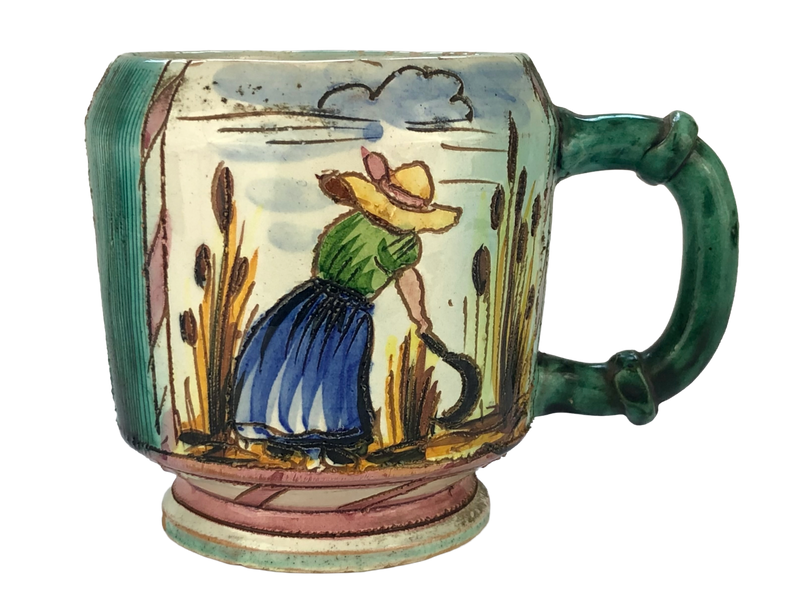
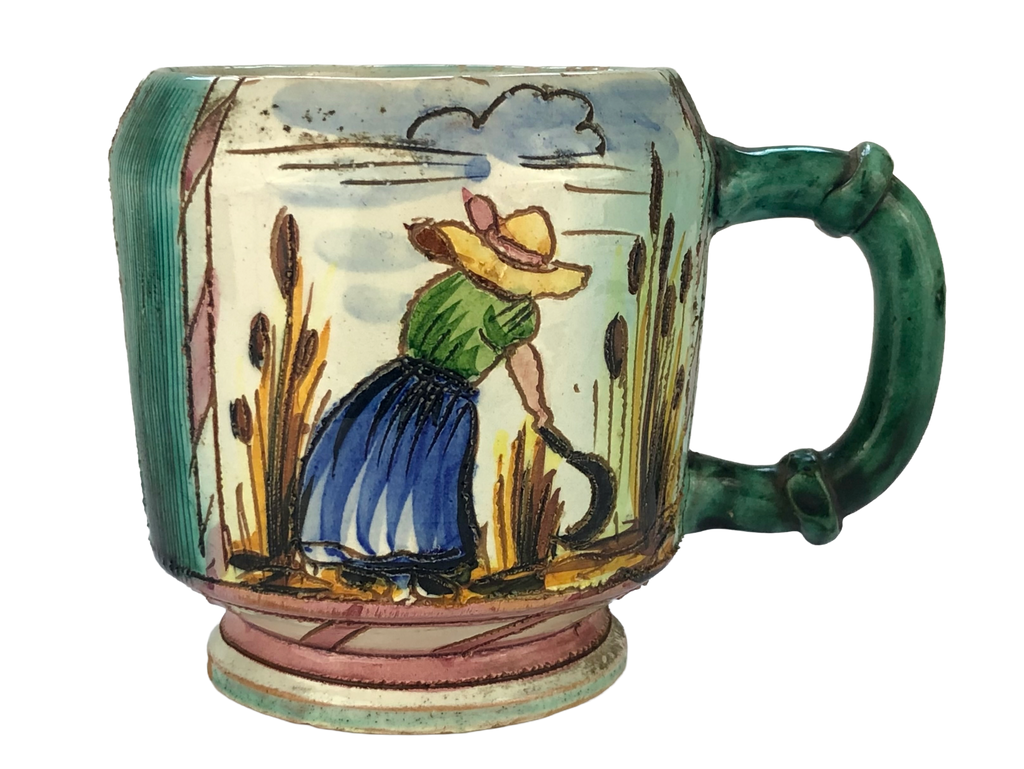
Vintage Italian sgraffito pottery mug depicting a woman in a yellow hat cutting reeds, with a green handle and pink foot.
{"id":10942723031199,"title":"Vintage Italian Sgraffito Pottery Mug, Hand-Decorated Rural Scene, 1950s–60s","handle":"vintage-italian-sgraffito-pottery-mug-hand-decorated-rural-scene-1950s-60s","description":"\u003cp\u003e\u003cspan\u003eThis wonderfully characterful mid-century sgraffito pottery mug captures a little scene of country life, with a woman in a wide-brimmed yellow straw hat, bright green blouse and flowing blue skirt, bending to cut reeds with a sickle. The scene is full of movement and colour, with tall grasses, a loosely sketched sky and bold turquoise-green panels framing the decoration. The dark incised outlines, lively brushwork and substantial sculptural handle give it a distinctly rustic, handmade quality.\u003c\/span\u003e\u003c\/p\u003e\n\u003cp\u003e\u003cspan\u003eSgraffito has a long history in Italian ceramics, going back to the Renaissance, when potters used the technique to create decorative patterns by scratching through a layer of coloured slip to reveal the clay beneath. It continued to be used by Italian workshops well into the 20th century, particularly for the colourful decorative pottery produced for the growing tourist and export markets after the Second World War.\u003c\/span\u003e\u003c\/p\u003e\n\u003cp\u003e\u003cspan\u003eWhat I particularly like here is the almost storybook quality of the decoration. The woman bends forward with a small sickle in her hand, surrounded by tall rushes beneath a loosely sketched sky. The colours are wonderfully lively, with turquoise green, deep blue, pink and warm yellow all outlined in dark brown. The reverse is equally interesting, covered in closely spaced vertical incised lines, with alternating bands of green and pale pink. Even the substantial green handle, with its slightly unusual raised attachments, has a decorative quality of its own.\u003c\/span\u003e\u003c\/p\u003e\n\u003cp\u003e\u003cspan\u003eThe underside is stamped \u003c\/span\u003e\u003cstrong\u003e\u003cspan\u003e\"54\/155 FOREIGN\"\u003c\/span\u003e\u003c\/strong\u003e\u003cspan\u003e, probably a workshop shape or production reference together with an export designation. Although the style is consistent with mid-century Italian decorative pottery, probably dating to the 1950s or 1960s, the precise workshop and region have not been identified.\u003c\/span\u003e\u003c\/p\u003e\n\u003cp\u003e\u003cspan\u003e\u003cmeta charset=\"UTF-8\"\u003e \u003cstrong\u003eDimensions approximate \u003c\/strong\u003e: 11 cm tall \u003c\/span\u003e\u003c\/p\u003e\n\u003cp\u003e\u003cstrong\u003e\u003cspan\u003eCondition:\u003c\/span\u003e\u003c\/strong\u003e\u003cspan\u003e Good vintage condition, with minor surface marks and signs of age. There are some original factory glaze irregularities, including small areas where the glaze did not fully cover the clay during manufacture. These are part of the original finish rather than later damage and are entirely in keeping with the character of this hand-decorated pottery. No obvious major chips or cracks are visible.\u003c\/span\u003e\u003c\/p\u003e\n\u003cp\u003e\u003cstrong\u003e\u003cspan\u003eCollector's note:\u003c\/span\u003e\u003c\/strong\u003e\u003cspan\u003e What appeals to me about this mug is how much personality it has. The subject belongs to an older tradition of rural scenes and folk decoration, but the bold colours and simplified drawing give it a distinctly mid-century feel. These decorative ceramics were made to bring a little colour and a sense of place into the home, often capturing an idealised version of country life. This one is particularly cheerful, with its lively figure, deeply textured green background and rather generous proportions. It works beautifully as a decorative piece in its own right.\u003c\/span\u003e\u003c\/p\u003e\n\u003cp\u003e\u003cstrong\u003e\u003cspan\u003eWorldwide Shipping:\u003c\/span\u003e\u003c\/strong\u003e\u003cspan\u003e We are always happy to ship worldwide. Your piece will be packed with great care and sent tracked.\u003c\/span\u003e\u003c\/p\u003e","published_at":"2026-11-04T16:11:54+00:00","created_at":"2026-11-04T14:57:41+00:00","vendor":"Eclectic Design ","type":"Mug","tags":["Hand-Decorated Pottery","Italian Pottery","Mid-Century Ceramics","Sgraffito","Vintage Mug"],"price":2500,"price_min":2500,"price_max":2500,"available":false,"price_varies":false,"compare_at_price":null,"compare_at_price_min":0,"compare_at_price_max":0,"compare_at_price_varies":false,"variants":[{"id":62902903865503,"title":"Default Title","option1":"Default Title","option2":null,"option3":null,"sku":null,"requires_shipping":true,"taxable":true,"featured_image":null,"available":false,"name":"Vintage Italian Sgraffito Pottery Mug, Hand-Decorated Rural Scene, 1950s–60s","public_title":null,"options":["Default Title"],"price":2500,"weight":1000,"compare_at_price":null,"inventory_quantity":null,"inventory_management":"shopify","inventory_policy":"deny","barcode":null,"requires_selling_plan":false,"selling_plan_allocations":[],"quantity_rule":{"min":1,"max":null,"increment":1}}],"images":["\/\/eclecticdesignlondon.com\/cdn\/shop\/files\/IMG_4323.png?v=1793807293","\/\/eclecticdesignlondon.com\/cdn\/shop\/files\/IMG_4317.png?v=1793807484","\/\/eclecticdesignlondon.com\/cdn\/shop\/files\/IMG_4331.png?v=1793807341","\/\/eclecticdesignlondon.com\/cdn\/shop\/files\/IMG_4320.png?v=1793808107","\/\/eclecticdesignlondon.com\/cdn\/shop\/files\/IMG_4341.png?v=1793807382","\/\/eclecticdesignlondon.com\/cdn\/shop\/files\/IMG_4334.png?v=1793807218"],"featured_image":"\/\/eclecticdesignlondon.com\/cdn\/shop\/files\/IMG_4323.png?v=1793807293","options":["Title"],"media":[{"alt":"Vintage Italian sgraffito pottery mug depicting a woman in a yellow hat cutting reeds, with a green handle and pink foot.","id":54648769183903,"position":1,"preview_image":{"aspect_ratio":1.332,"height":2417,"width":3220,"src":"\/\/eclecticdesignlondon.com\/cdn\/shop\/files\/IMG_4323.png?v=1793807293"},"aspect_ratio":1.332,"height":2417,"media_type":"image","src":"\/\/eclecticdesignlondon.com\/cdn\/shop\/files\/IMG_4323.png?v=1793807293","width":3220},{"alt":"Side view of Italian sgraffito pottery mug showing its curved green handle, incised decoration and part of the rural scene.","id":54648769151135,"position":2,"preview_image":{"aspect_ratio":1.332,"height":2260,"width":3010,"src":"\/\/eclecticdesignlondon.com\/cdn\/shop\/files\/IMG_4317.png?v=1793807484"},"aspect_ratio":1.332,"height":2260,"media_type":"image","src":"\/\/eclecticdesignlondon.com\/cdn\/shop\/files\/IMG_4317.png?v=1793807484","width":3010},{"alt":"Reverse of vintage Italian pottery mug with finely incised turquoise-green panels, pale pink bands and a green handle.","id":54648769052831,"position":3,"preview_image":{"aspect_ratio":1.332,"height":2609,"width":3476,"src":"\/\/eclecticdesignlondon.com\/cdn\/shop\/files\/IMG_4331.png?v=1793807341"},"aspect_ratio":1.332,"height":2609,"media_type":"image","src":"\/\/eclecticdesignlondon.com\/cdn\/shop\/files\/IMG_4331.png?v=1793807341","width":3476},{"alt":"Side view of sgraffito pottery mug showing turquoise-green striped panels, pink detailing and a raised circular foot.","id":54648771117215,"position":4,"preview_image":{"aspect_ratio":1.133,"height":2201,"width":2494,"src":"\/\/eclecticdesignlondon.com\/cdn\/shop\/files\/IMG_4320.png?v=1793808107"},"aspect_ratio":1.133,"height":2201,"media_type":"image","src":"\/\/eclecticdesignlondon.com\/cdn\/shop\/files\/IMG_4320.png?v=1793808107","width":2494},{"alt":"op view of vintage Italian pottery mug showing its cream-glazed interior, decorated rim and green handle.\n","id":54648769085599,"position":5,"preview_image":{"aspect_ratio":0.75,"height":3582,"width":2687,"src":"\/\/eclecticdesignlondon.com\/cdn\/shop\/files\/IMG_4341.png?v=1793807382"},"aspect_ratio":0.75,"height":3582,"media_type":"image","src":"\/\/eclecticdesignlondon.com\/cdn\/shop\/files\/IMG_4341.png?v=1793807382","width":2687},{"alt":"Underside of vintage Italian sgraffito pottery mug showing the black “54\/155 FOREIGN” stamp and unglazed foot ring.","id":54648769216671,"position":6,"preview_image":{"aspect_ratio":1.333,"height":3024,"width":4032,"src":"\/\/eclecticdesignlondon.com\/cdn\/shop\/files\/IMG_4334.png?v=1793807218"},"aspect_ratio":1.333,"height":3024,"media_type":"image","src":"\/\/eclecticdesignlondon.com\/cdn\/shop\/files\/IMG_4334.png?v=1793807218","width":4032}],"requires_selling_plan":false,"selling_plan_groups":[],"content":"\u003cp\u003e\u003cspan\u003eThis wonderfully characterful mid-century sgraffito pottery mug captures a little scene of country life, with a woman in a wide-brimmed yellow straw hat, bright green blouse and flowing blue skirt, bending to cut reeds with a sickle. The scene is full of movement and colour, with tall grasses, a loosely sketched sky and bold turquoise-green panels framing the decoration. The dark incised outlines, lively brushwork and substantial sculptural handle give it a distinctly rustic, handmade quality.\u003c\/span\u003e\u003c\/p\u003e\n\u003cp\u003e\u003cspan\u003eSgraffito has a long history in Italian ceramics, going back to the Renaissance, when potters used the technique to create decorative patterns by scratching through a layer of coloured slip to reveal the clay beneath. It continued to be used by Italian workshops well into the 20th century, particularly for the colourful decorative pottery produced for the growing tourist and export markets after the Second World War.\u003c\/span\u003e\u003c\/p\u003e\n\u003cp\u003e\u003cspan\u003eWhat I particularly like here is the almost storybook quality of the decoration. The woman bends forward with a small sickle in her hand, surrounded by tall rushes beneath a loosely sketched sky. The colours are wonderfully lively, with turquoise green, deep blue, pink and warm yellow all outlined in dark brown. The reverse is equally interesting, covered in closely spaced vertical incised lines, with alternating bands of green and pale pink. Even the substantial green handle, with its slightly unusual raised attachments, has a decorative quality of its own.\u003c\/span\u003e\u003c\/p\u003e\n\u003cp\u003e\u003cspan\u003eThe underside is stamped \u003c\/span\u003e\u003cstrong\u003e\u003cspan\u003e\"54\/155 FOREIGN\"\u003c\/span\u003e\u003c\/strong\u003e\u003cspan\u003e, probably a workshop shape or production reference together with an export designation. Although the style is consistent with mid-century Italian decorative pottery, probably dating to the 1950s or 1960s, the precise workshop and region have not been identified.\u003c\/span\u003e\u003c\/p\u003e\n\u003cp\u003e\u003cspan\u003e\u003cmeta charset=\"UTF-8\"\u003e \u003cstrong\u003eDimensions approximate \u003c\/strong\u003e: 11 cm tall \u003c\/span\u003e\u003c\/p\u003e\n\u003cp\u003e\u003cstrong\u003e\u003cspan\u003eCondition:\u003c\/span\u003e\u003c\/strong\u003e\u003cspan\u003e Good vintage condition, with minor surface marks and signs of age. There are some original factory glaze irregularities, including small areas where the glaze did not fully cover the clay during manufacture. These are part of the original finish rather than later damage and are entirely in keeping with the character of this hand-decorated pottery. No obvious major chips or cracks are visible.\u003c\/span\u003e\u003c\/p\u003e\n\u003cp\u003e\u003cstrong\u003e\u003cspan\u003eCollector's note:\u003c\/span\u003e\u003c\/strong\u003e\u003cspan\u003e What appeals to me about this mug is how much personality it has. The subject belongs to an older tradition of rural scenes and folk decoration, but the bold colours and simplified drawing give it a distinctly mid-century feel. These decorative ceramics were made to bring a little colour and a sense of place into the home, often capturing an idealised version of country life. This one is particularly cheerful, with its lively figure, deeply textured green background and rather generous proportions. It works beautifully as a decorative piece in its own right.\u003c\/span\u003e\u003c\/p\u003e\n\u003cp\u003e\u003cstrong\u003e\u003cspan\u003eWorldwide Shipping:\u003c\/span\u003e\u003c\/strong\u003e\u003cspan\u003e We are always happy to ship worldwide. Your piece will be packed with great care and sent tracked.\u003c\/span\u003e\u003c\/p\u003e"}
Vintage Italian sgraffito pottery mug depicting a woman in a yellow hat cutting reeds, with a green handle and pink foot.

Vintage Italian Sgraffito Pottery Mug, Hand-Decorated Rural Scene, 1950s–60s

£25.00

This wonderfully characterful mid-century sgraffito pottery mug captures a little scene of country life, with a woman in a wide-brimmed yellow straw hat, bright green blouse and flowing blue skirt, bending to cut reeds with a sickle. The scene is full of movement and colour, with tall grasses, a loosely sketched sky and bold turquoise-green pane...

Περισσότερες πληροφορίες
{"id":10942752293023,"title":"Antique Victorian Pekin Pattern Syrup Jug with Pewter Lid, c.1860–1880","handle":"antique-victorian-pekin-pattern-syrup-jug-with-pewter-lid-c-1860-1880","description":"\u003cp\u003e\u003cimg\u003e\u003cimg\u003e\u003cmeta charset=\"UTF-8\"\u003e\u003cspan\u003eThis handsome Victorian Staffordshire syrup jug, dating to around 1860–1880, is decorated in the colourful Chinoiserie Pekin pattern, associated with Beech \u0026amp; Hancock and later James Beech. Its elegant pear-shaped body is fitted with a substantial hinged pewter lid, while the decoration depicts an imagined Chinese garden scene in softly coloured enamels.\u003c\/span\u003e\u003c\/p\u003e\n\u003cp data-pm-slice=\"1 1 []\"\u003e\u003cspan\u003ePekin belongs to the Victorian fascination with China and the wider East, when Staffordshire potteries produced romanticised scenes of distant places for British dining tables. These designs owed more to the European imagination than to everyday life in China, but they were enormously popular and often surprisingly elaborate.\u003c\/span\u003e\u003c\/p\u003e\n\u003cp\u003e\u003cspan\u003eWhat I particularly like about this jug is the contrast between the delicate, almost theatrical scene and the substantial pewter lid. The colours remain wonderfully attractive, and the softly shaped body, with its narrow neck and generous rounded base, has a pleasing elegance. It is a decorative object in its own right, quite apart from its original purpose.\u003c\/span\u003e\u003c\/p\u003e\n\u003cp\u003e\u003cspan\u003eThe underside carries a small iron-red painted mark but no manufacturer's backstamp. Examples of the Pekin pattern are known both marked and unmarked, although the precise factory attribution of this jug remains uncertain.\u003c\/span\u003e\u003c\/p\u003e\n\u003cp\u003e\u003cspan\u003e\u003cstrong\u003eDimensions Approximate: \u003c\/strong\u003eHeight\u003cstrong\u003e \u003c\/strong\u003e6 1\/2\" (16.5cm)  x Width 4 1\/2\" (11.5cm) from spout to handle. \u003c\/span\u003e\u003c\/p\u003e\n\u003cp data-pm-slice=\"1 1 []\"\u003e\u003cstrong\u003e\u003cspan\u003eCondition:\u003c\/span\u003e\u003c\/strong\u003e\u003cspan\u003e Good antique condition with age-related discolouration, light staining and some wear to the decoration. The hinged pewter lid retains its attractive aged patina. A faint surface line is visible near the base, although its nature has not been established. The colourful decoration remains particularly well preserved.\u003c\/span\u003e\u003c\/p\u003e\n\u003cp\u003e\u003cstrong\u003e\u003cspan\u003eCollector's note:\u003c\/span\u003e\u003c\/strong\u003e\u003cspan\u003e Victorian Chinoiserie tells us as much about British tastes as it does about the countries it was intended to represent. This jug is a particularly appealing survivor, combining colourful Staffordshire decoration with traditional pewter craftsmanship. More than 140 years on, it still has considerable presence.\u003c\/span\u003e\u003c\/p\u003e\n\u003cp\u003e\u003cstrong\u003e\u003cspan\u003eWorldwide Shipping:\u003c\/span\u003e\u003c\/strong\u003e\u003cspan\u003e We are always happy to ship worldwide. Your piece will be packed with great care and sent tracked.\u003c\/span\u003e\u003c\/p\u003e","published_at":"2026-11-04T19:21:13+00:00","created_at":"2026-11-04T18:31:01+00:00","vendor":"Eclectic Design ","type":"Jug","tags":["19th Century","Antique","Antique Ceramics","Chinoiserie","Decorative Jug","Pekin Pattern","Pewter Lid","Staffordshire Pottery","Syrup Jug","Victorian"],"price":8000,"price_min":8000,"price_max":8000,"available":true,"price_varies":false,"compare_at_price":null,"compare_at_price_min":0,"compare_at_price_max":0,"compare_at_price_varies":false,"variants":[{"id":62903042736287,"title":"Default Title","option1":"Default Title","option2":null,"option3":null,"sku":null,"requires_shipping":true,"taxable":true,"featured_image":null,"available":true,"name":"Antique Victorian Pekin Pattern Syrup Jug with Pewter Lid, c.1860–1880","public_title":null,"options":["Default Title"],"price":8000,"weight":1500,"compare_at_price":null,"inventory_quantity":1,"inventory_management":"shopify","inventory_policy":"deny","barcode":null,"requires_selling_plan":false,"selling_plan_allocations":[],"quantity_rule":{"min":1,"max":null,"increment":1}}],"images":["\/\/eclecticdesignlondon.com\/cdn\/shop\/files\/IMG_4929.png?v=1793819065","\/\/eclecticdesignlondon.com\/cdn\/shop\/files\/IMG_4939.png?v=1793819299","\/\/eclecticdesignlondon.com\/cdn\/shop\/files\/IMG_4937.png?v=1793819363","\/\/eclecticdesignlondon.com\/cdn\/shop\/files\/IMG_4912.png?v=1793819816","\/\/eclecticdesignlondon.com\/cdn\/shop\/files\/IMG_4898.png?v=1793819113","\/\/eclecticdesignlondon.com\/cdn\/shop\/files\/IMG_4901.png?v=1793819154","\/\/eclecticdesignlondon.com\/cdn\/shop\/files\/IMG_4926-2.png?v=1793819244","\/\/eclecticdesignlondon.com\/cdn\/shop\/files\/IMG_4928.png?v=1793819209","\/\/eclecticdesignlondon.com\/cdn\/shop\/files\/IMG_4946.png?v=1793819865","\/\/eclecticdesignlondon.com\/cdn\/shop\/files\/IMG_4923_835158e6-cf26-4e45-b54d-bd7739a7a39f.png?v=1793819916"],"featured_image":"\/\/eclecticdesignlondon.com\/cdn\/shop\/files\/IMG_4929.png?v=1793819065","options":["Title"],"media":[{"alt":"Victorian Pekin pattern syrup jug with colourful chinoiserie figures, palm trees, a geometric rim border and hinged pewter lid.","id":54648871649439,"position":1,"preview_image":{"aspect_ratio":0.75,"height":3836,"width":2877,"src":"\/\/eclecticdesignlondon.com\/cdn\/shop\/files\/IMG_4929.png?v=1793819065"},"aspect_ratio":0.75,"height":3836,"media_type":"image","src":"\/\/eclecticdesignlondon.com\/cdn\/shop\/files\/IMG_4929.png?v=1793819065","width":2877},{"alt":"Spout-facing view of the Victorian Pekin syrup jug, showing its cream body, floral decoration and pewter lid.","id":54648872534175,"position":2,"preview_image":{"aspect_ratio":0.633,"height":3725,"width":2357,"src":"\/\/eclecticdesignlondon.com\/cdn\/shop\/files\/IMG_4939.png?v=1793819299"},"aspect_ratio":0.633,"height":3725,"media_type":"image","src":"\/\/eclecticdesignlondon.com\/cdn\/shop\/files\/IMG_4939.png?v=1793819299","width":2357},{"alt":"Opposite side of the Victorian Pekin syrup jug, showing three chinoiserie figures beneath palm trees and a curved handle.","id":54648872501407,"position":3,"preview_image":{"aspect_ratio":0.75,"height":3740,"width":2805,"src":"\/\/eclecticdesignlondon.com\/cdn\/shop\/files\/IMG_4937.png?v=1793819363"},"aspect_ratio":0.75,"height":3740,"media_type":"image","src":"\/\/eclecticdesignlondon.com\/cdn\/shop\/files\/IMG_4937.png?v=1793819363","width":2805},{"alt":"Rear view of the Pekin syrup jug, showing the dark geometric pattern along the handle and the closed pewter lid.","id":54648887509151,"position":4,"preview_image":{"aspect_ratio":0.794,"height":2453,"width":1948,"src":"\/\/eclecticdesignlondon.com\/cdn\/shop\/files\/IMG_4912.png?v=1793819816"},"aspect_ratio":0.794,"height":2453,"media_type":"image","src":"\/\/eclecticdesignlondon.com\/cdn\/shop\/files\/IMG_4912.png?v=1793819816","width":1948},{"alt":"Top view of the syrup jug’s closed pewter lid, showing its shaped outline, decorative thumbpiece and hinge.","id":54648869978271,"position":5,"preview_image":{"aspect_ratio":0.75,"height":3296,"width":2472,"src":"\/\/eclecticdesignlondon.com\/cdn\/shop\/files\/IMG_4898.png?v=1793819113"},"aspect_ratio":0.75,"height":3296,"media_type":"image","src":"\/\/eclecticdesignlondon.com\/cdn\/shop\/files\/IMG_4898.png?v=1793819113","width":2472},{"alt":"Victorian syrup jug with its hinged pewter lid raised, showing the cream interior, pouring spout and underside of the lid.","id":54648870371487,"position":6,"preview_image":{"aspect_ratio":0.75,"height":3784,"width":2838,"src":"\/\/eclecticdesignlondon.com\/cdn\/shop\/files\/IMG_4901.png?v=1793819154"},"aspect_ratio":0.75,"height":3784,"media_type":"image","src":"\/\/eclecticdesignlondon.com\/cdn\/shop\/files\/IMG_4901.png?v=1793819154","width":2838},{"alt":"Close-up of the jug’s handle and upper attachment beside a seated chinoiserie figure and palm tree decoration.","id":54648870666399,"position":7,"preview_image":{"aspect_ratio":0.661,"height":4032,"width":2665,"src":"\/\/eclecticdesignlondon.com\/cdn\/shop\/files\/IMG_4926-2.png?v=1793819244"},"aspect_ratio":0.661,"height":4032,"media_type":"image","src":"\/\/eclecticdesignlondon.com\/cdn\/shop\/files\/IMG_4926-2.png?v=1793819244","width":2665},{"alt":"Close-up of the opposite side of the jug’s curved handle, with floral decoration and a seated figure in pink.","id":54648871387295,"position":8,"preview_image":{"aspect_ratio":0.637,"height":4033,"width":2568,"src":"\/\/eclecticdesignlondon.com\/cdn\/shop\/files\/IMG_4928.png?v=1793819209"},"aspect_ratio":0.637,"height":4033,"media_type":"image","src":"\/\/eclecticdesignlondon.com\/cdn\/shop\/files\/IMG_4928.png?v=1793819209","width":2568},{"alt":"Angled underside view of the Victorian Pekin syrup jug, showing the circular foot ring, surface wear and floral decoration.","id":54648887771295,"position":9,"preview_image":{"aspect_ratio":0.75,"height":4032,"width":3024,"src":"\/\/eclecticdesignlondon.com\/cdn\/shop\/files\/IMG_4946.png?v=1793819865"},"aspect_ratio":0.75,"height":4032,"media_type":"image","src":"\/\/eclecticdesignlondon.com\/cdn\/shop\/files\/IMG_4946.png?v=1793819865","width":3024},{"alt":"Close-up of the syrup jug’s cream base, showing a small red painted mark and wear around the foot ring.","id":54648888000671,"position":10,"preview_image":{"aspect_ratio":0.75,"height":4032,"width":3024,"src":"\/\/eclecticdesignlondon.com\/cdn\/shop\/files\/IMG_4923_835158e6-cf26-4e45-b54d-bd7739a7a39f.png?v=1793819916"},"aspect_ratio":0.75,"height":4032,"media_type":"image","src":"\/\/eclecticdesignlondon.com\/cdn\/shop\/files\/IMG_4923_835158e6-cf26-4e45-b54d-bd7739a7a39f.png?v=1793819916","width":3024}],"requires_selling_plan":false,"selling_plan_groups":[],"content":"\u003cp\u003e\u003cimg\u003e\u003cimg\u003e\u003cmeta charset=\"UTF-8\"\u003e\u003cspan\u003eThis handsome Victorian Staffordshire syrup jug, dating to around 1860–1880, is decorated in the colourful Chinoiserie Pekin pattern, associated with Beech \u0026amp; Hancock and later James Beech. Its elegant pear-shaped body is fitted with a substantial hinged pewter lid, while the decoration depicts an imagined Chinese garden scene in softly coloured enamels.\u003c\/span\u003e\u003c\/p\u003e\n\u003cp data-pm-slice=\"1 1 []\"\u003e\u003cspan\u003ePekin belongs to the Victorian fascination with China and the wider East, when Staffordshire potteries produced romanticised scenes of distant places for British dining tables. These designs owed more to the European imagination than to everyday life in China, but they were enormously popular and often surprisingly elaborate.\u003c\/span\u003e\u003c\/p\u003e\n\u003cp\u003e\u003cspan\u003eWhat I particularly like about this jug is the contrast between the delicate, almost theatrical scene and the substantial pewter lid. The colours remain wonderfully attractive, and the softly shaped body, with its narrow neck and generous rounded base, has a pleasing elegance. It is a decorative object in its own right, quite apart from its original purpose.\u003c\/span\u003e\u003c\/p\u003e\n\u003cp\u003e\u003cspan\u003eThe underside carries a small iron-red painted mark but no manufacturer's backstamp. Examples of the Pekin pattern are known both marked and unmarked, although the precise factory attribution of this jug remains uncertain.\u003c\/span\u003e\u003c\/p\u003e\n\u003cp\u003e\u003cspan\u003e\u003cstrong\u003eDimensions Approximate: \u003c\/strong\u003eHeight\u003cstrong\u003e \u003c\/strong\u003e6 1\/2\" (16.5cm)  x Width 4 1\/2\" (11.5cm) from spout to handle. \u003c\/span\u003e\u003c\/p\u003e\n\u003cp data-pm-slice=\"1 1 []\"\u003e\u003cstrong\u003e\u003cspan\u003eCondition:\u003c\/span\u003e\u003c\/strong\u003e\u003cspan\u003e Good antique condition with age-related discolouration, light staining and some wear to the decoration. The hinged pewter lid retains its attractive aged patina. A faint surface line is visible near the base, although its nature has not been established. The colourful decoration remains particularly well preserved.\u003c\/span\u003e\u003c\/p\u003e\n\u003cp\u003e\u003cstrong\u003e\u003cspan\u003eCollector's note:\u003c\/span\u003e\u003c\/strong\u003e\u003cspan\u003e Victorian Chinoiserie tells us as much about British tastes as it does about the countries it was intended to represent. This jug is a particularly appealing survivor, combining colourful Staffordshire decoration with traditional pewter craftsmanship. More than 140 years on, it still has considerable presence.\u003c\/span\u003e\u003c\/p\u003e\n\u003cp\u003e\u003cstrong\u003e\u003cspan\u003eWorldwide Shipping:\u003c\/span\u003e\u003c\/strong\u003e\u003cspan\u003e We are always happy to ship worldwide. Your piece will be packed with great care and sent tracked.\u003c\/span\u003e\u003c\/p\u003e"}
Victorian Pekin pattern syrup jug with colourful chinoiserie figures, palm trees, a geometric rim border and hinged pewter lid.

Antique Victorian Pekin Pattern Syrup Jug with Pewter Lid, c.1860–1880

£80.00

This handsome Victorian Staffordshire syrup jug, dating to around 1860–1880, is decorated in the colourful Chinoiserie Pekin pattern, associated with Beech & Hancock and later James Beech. Its elegant pear-shaped body is fitted with a substantial hinged pewter lid, while the decoration depicts an imagined Chinese garden scene in softly colou...
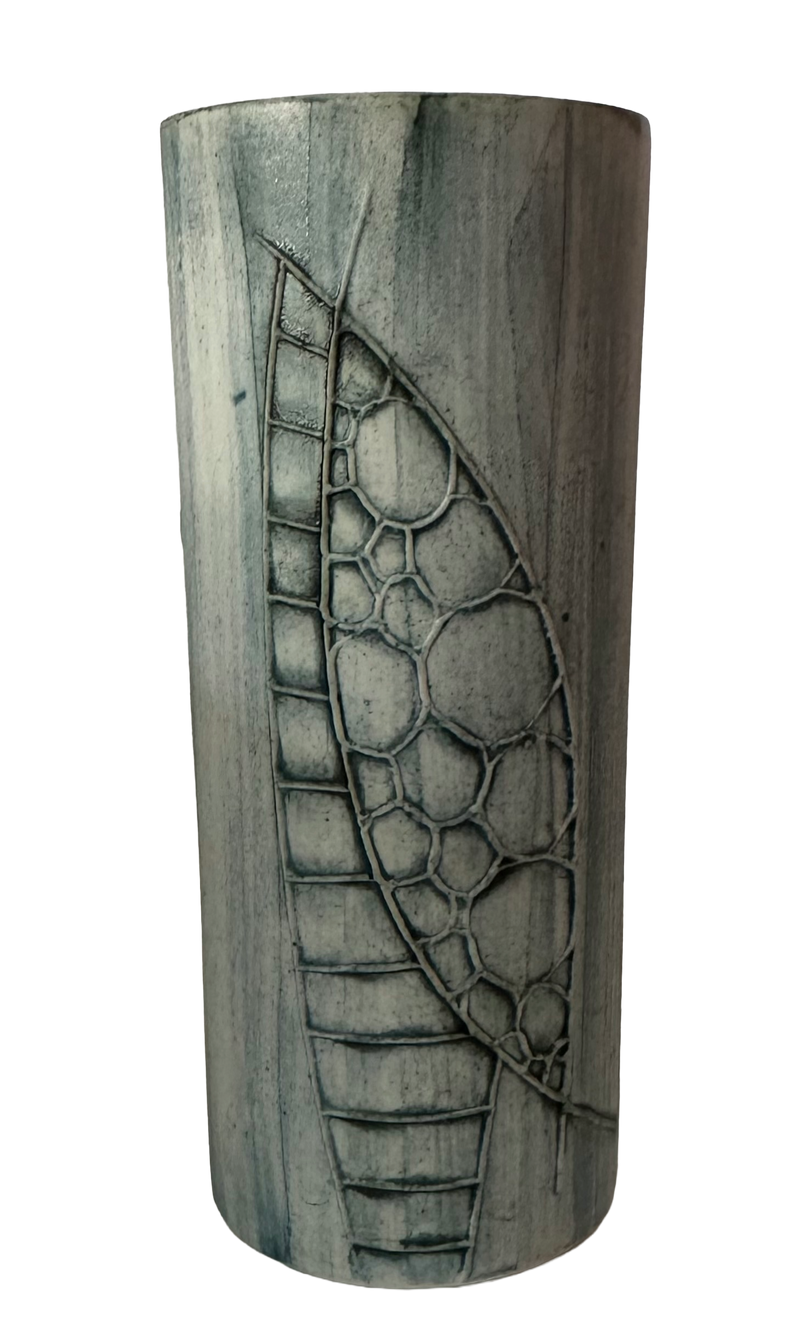
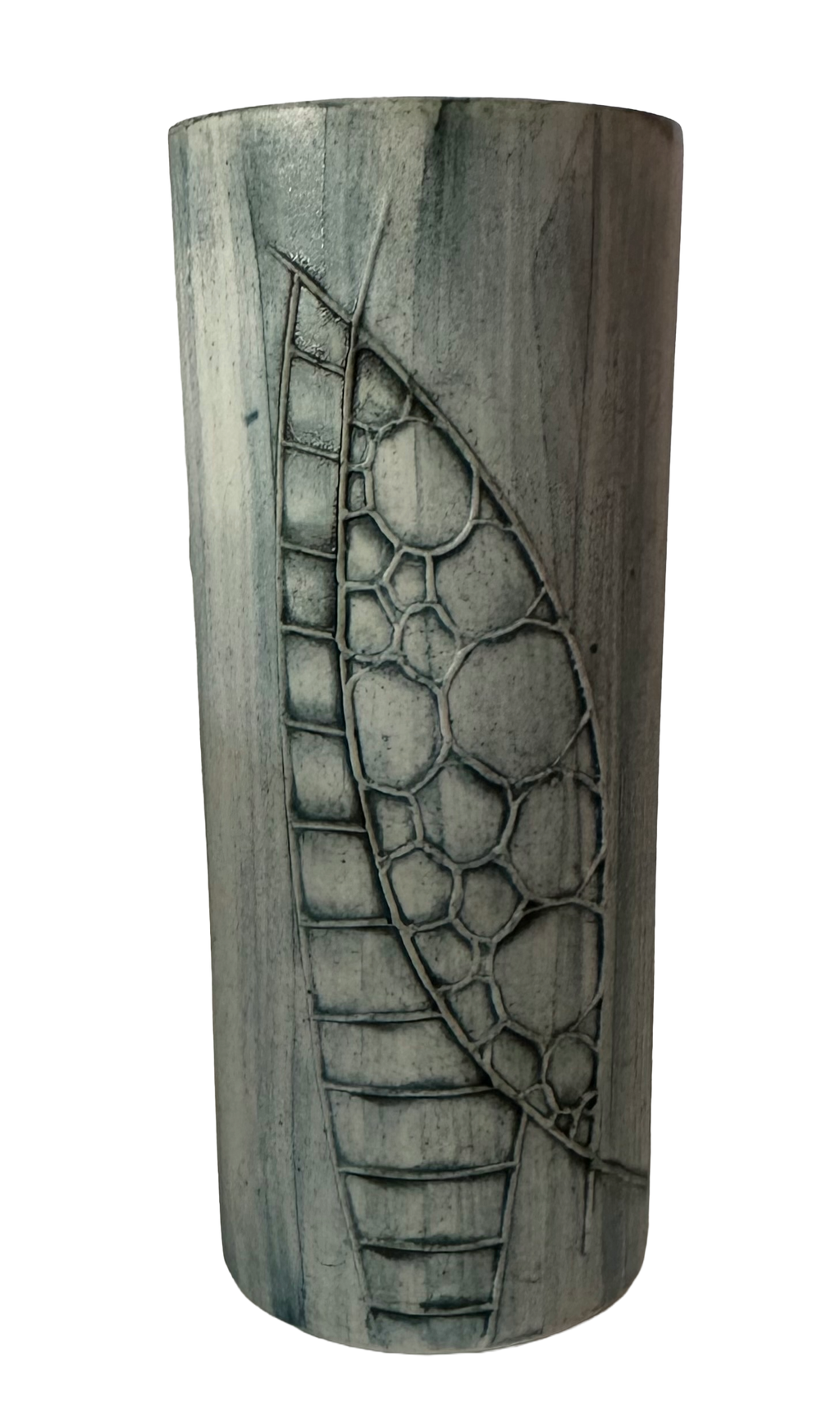
Περισσότερες πληροφορίες
{"id":10942971052191,"title":"Vintage Carn Pottery Vase, John Beusmans, Cornish Studio Pottery, 1970s–80s","handle":"vintage-carn-pottery-vase-john-beusmans-cornish-studio-pottery-1970s-80s","description":"\u003cp data-pm-slice=\"1 1 []\"\u003e\u003cspan\u003eThis distinctive vintage Carn Pottery vase, made in Nancledra, Cornwall, has a simple cylindrical form decorated with two quite different designs. One side features a large stylised flower with deeply outlined petals, while the reverse has an abstract arrangement of irregular, cell-like shapes and geometric lines. The softly washed blue, grey and sea-green finish settles into the textured decoration, giving the surface an almost weathered appearance.\u003c\/span\u003e\u003c\/p\u003e\n\u003cp\u003e\u003cspan\u003eCarn Pottery was established in 1971 by John Michael Beusmans in an old chapel at Nancledra, near Penzance. Having trained at Redruth School of Art, Beusmans developed a distinctive style combining sculptural forms with organic and geometric decoration. His work sits comfortably alongside the innovative Cornish studio pottery of the period, including Troika and Tremaen, although Carn developed a very recognisable character of its own.\u003c\/span\u003e\u003c\/p\u003e\n\u003cp\u003e\u003cspan\u003eOne of the interesting features of Carn pottery is the use of different designs on opposing sides. Rather than treating the back as an afterthought, Beusmans gave many of his pieces two distinct faces. Here, the bold flower contrasts with the almost cellular pattern on the reverse, making it possible to change the appearance of the vase simply by turning it around.\u003c\/span\u003e\u003c\/p\u003e\n\u003cp\u003e\u003cspan\u003eThe underside carries the printed \u003c\/span\u003e\u003cstrong\u003e\u003cspan\u003eCarn Pottery, Nancledra, Penzance, Cornwall\u003c\/span\u003e\u003c\/strong\u003e\u003cspan\u003e stamp. There is no individual signature or date mark.\u003c\/span\u003e\u003c\/p\u003e\n\u003cp\u003e\u003cstrong\u003e\u003cspan\u003eApproximate Size:\u003c\/span\u003e\u003c\/strong\u003e\u003cspan\u003e Height 15 cm. Diameter 6.2 cm.\u003c\/span\u003e\u003c\/p\u003e\n\u003cp\u003e\u003cstrong\u003e\u003cspan\u003eCondition:\u003c\/span\u003e\u003c\/strong\u003e\u003cspan\u003e Excellent vintage condition, with no chips, cracks or flea bites. The textured decoration and softly coloured finish are well preserved, with the natural variations characteristic of Carn pottery.\u003c\/span\u003e\u003c\/p\u003e\n\u003cp\u003e\u003cstrong\u003e\u003cspan\u003eCollector's note:\u003c\/span\u003e\u003c\/strong\u003e\u003cspan\u003e Carn is an interesting part of the Cornish studio pottery movement of the 1970s and 1980s. While Troika became particularly famous for its architectural forms and textured surfaces, John Beusmans developed his own approach, drawing on flowers, natural structures and abstract patterns. This vase is a good example of his work, particularly with its two contrasting designs and restrained blue-green colouring.\u003c\/span\u003e\u003c\/p\u003e\n\u003cp\u003e\u003cstrong\u003e\u003cspan\u003eWorldwide Shipping:\u003c\/span\u003e\u003c\/strong\u003e\u003cspan\u003e We are always happy to ship worldwide. Your piece will be packed with great care and sent tracked.\u003c\/span\u003e\u003c\/p\u003e","published_at":"2026-11-06T08:08:27+00:00","created_at":"2026-11-06T07:22:05+00:00","vendor":"Eclectic Design ","type":"Vase","tags":["Carn Pottery","Cornish Studio Pottery","Floral Vase","John Beusmans","Vintage Vase"],"price":4500,"price_min":4500,"price_max":4500,"available":true,"price_varies":false,"compare_at_price":null,"compare_at_price_min":0,"compare_at_price_max":0,"compare_at_price_varies":false,"variants":[{"id":62903883169951,"title":"Default Title","option1":"Default Title","option2":null,"option3":null,"sku":null,"requires_shipping":true,"taxable":true,"featured_image":null,"available":true,"name":"Vintage Carn Pottery Vase, John Beusmans, Cornish Studio Pottery, 1970s–80s","public_title":null,"options":["Default Title"],"price":4500,"weight":1000,"compare_at_price":null,"inventory_quantity":1,"inventory_management":"shopify","inventory_policy":"deny","barcode":null,"requires_selling_plan":false,"selling_plan_allocations":[],"quantity_rule":{"min":1,"max":null,"increment":1}}],"images":["\/\/eclecticdesignlondon.com\/cdn\/shop\/files\/IMG_9975.png?v=1793950774","\/\/eclecticdesignlondon.com\/cdn\/shop\/files\/IMG_9979.png?v=1793950827","\/\/eclecticdesignlondon.com\/cdn\/shop\/files\/IMG_9984.png?v=1793952302","\/\/eclecticdesignlondon.com\/cdn\/shop\/files\/IMG_9977.png?v=1793950890","\/\/eclecticdesignlondon.com\/cdn\/shop\/files\/IMG_9972.png?v=1793950928","\/\/eclecticdesignlondon.com\/cdn\/shop\/files\/IMG_9974.png?v=1793950973","\/\/eclecticdesignlondon.com\/cdn\/shop\/files\/IMG_9982.png?v=1793952334"],"featured_image":"\/\/eclecticdesignlondon.com\/cdn\/shop\/files\/IMG_9975.png?v=1793950774","options":["Title"],"media":[{"alt":"Vintage Carn Pottery cylindrical vase with textured blue-grey and sea-green glaze and an abstract cellular pattern.","id":54651340882079,"position":1,"preview_image":{"aspect_ratio":0.596,"height":2453,"width":1463,"src":"\/\/eclecticdesignlondon.com\/cdn\/shop\/files\/IMG_9975.png?v=1793950774"},"aspect_ratio":0.596,"height":2453,"media_type":"image","src":"\/\/eclecticdesignlondon.com\/cdn\/shop\/files\/IMG_9975.png?v=1793950774","width":1463},{"alt":"Vintage Carn Pottery vase by John Beusmans with a large outlined flower and leaves in blue-grey and sea-green.","id":54651340816543,"position":2,"preview_image":{"aspect_ratio":0.571,"height":2410,"width":1377,"src":"\/\/eclecticdesignlondon.com\/cdn\/shop\/files\/IMG_9979.png?v=1793950827"},"aspect_ratio":0.571,"height":2410,"media_type":"image","src":"\/\/eclecticdesignlondon.com\/cdn\/shop\/files\/IMG_9979.png?v=1793950827","width":1377},{"alt":"Vintage Carn Pottery vase showing its blue-green abstract cellular decoration, circular rim and glazed interior.","id":54651349270687,"position":3,"preview_image":{"aspect_ratio":0.606,"height":3011,"width":1824,"src":"\/\/eclecticdesignlondon.com\/cdn\/shop\/files\/IMG_9984.png?v=1793952302"},"aspect_ratio":0.606,"height":3011,"media_type":"image","src":"\/\/eclecticdesignlondon.com\/cdn\/shop\/files\/IMG_9984.png?v=1793952302","width":1824},{"alt":" Angled view of the Carn Pottery floral vase showing its circular opening, glazed interior and textured decoration.","id":54651340849311,"position":4,"preview_image":{"aspect_ratio":0.578,"height":2427,"width":1404,"src":"\/\/eclecticdesignlondon.com\/cdn\/shop\/files\/IMG_9977.png?v=1793950890"},"aspect_ratio":0.578,"height":2427,"media_type":"image","src":"\/\/eclecticdesignlondon.com\/cdn\/shop\/files\/IMG_9977.png?v=1793950890","width":1404},{"alt":"Underside of the vintage vase showing the Carn Pottery, Nancledra, Penzance, Cornwall maker’s stamp.","id":54651341045919,"position":5,"preview_image":{"aspect_ratio":1.0,"height":2568,"width":2568,"src":"\/\/eclecticdesignlondon.com\/cdn\/shop\/files\/IMG_9972.png?v=1793950928"},"aspect_ratio":1.0,"height":2568,"media_type":"image","src":"\/\/eclecticdesignlondon.com\/cdn\/shop\/files\/IMG_9972.png?v=1793950928","width":2568},{"alt":"Close-up of the printed Carn Pottery maker’s mark reading Nancledra, Penzance, Cornwall.","id":54651341078687,"position":6,"preview_image":{"aspect_ratio":1.0,"height":3024,"width":3024,"src":"\/\/eclecticdesignlondon.com\/cdn\/shop\/files\/IMG_9974.png?v=1793950973"},"aspect_ratio":1.0,"height":3024,"media_type":"image","src":"\/\/eclecticdesignlondon.com\/cdn\/shop\/files\/IMG_9974.png?v=1793950973","width":3024},{"alt":"Top view of the vintage Carn Pottery vase showing the circular opening, pale green glazed rim and interior.","id":54651349303455,"position":7,"preview_image":{"aspect_ratio":0.996,"height":1595,"width":1589,"src":"\/\/eclecticdesignlondon.com\/cdn\/shop\/files\/IMG_9982.png?v=1793952334"},"aspect_ratio":0.996,"height":1595,"media_type":"image","src":"\/\/eclecticdesignlondon.com\/cdn\/shop\/files\/IMG_9982.png?v=1793952334","width":1589}],"requires_selling_plan":false,"selling_plan_groups":[],"content":"\u003cp data-pm-slice=\"1 1 []\"\u003e\u003cspan\u003eThis distinctive vintage Carn Pottery vase, made in Nancledra, Cornwall, has a simple cylindrical form decorated with two quite different designs. One side features a large stylised flower with deeply outlined petals, while the reverse has an abstract arrangement of irregular, cell-like shapes and geometric lines. The softly washed blue, grey and sea-green finish settles into the textured decoration, giving the surface an almost weathered appearance.\u003c\/span\u003e\u003c\/p\u003e\n\u003cp\u003e\u003cspan\u003eCarn Pottery was established in 1971 by John Michael Beusmans in an old chapel at Nancledra, near Penzance. Having trained at Redruth School of Art, Beusmans developed a distinctive style combining sculptural forms with organic and geometric decoration. His work sits comfortably alongside the innovative Cornish studio pottery of the period, including Troika and Tremaen, although Carn developed a very recognisable character of its own.\u003c\/span\u003e\u003c\/p\u003e\n\u003cp\u003e\u003cspan\u003eOne of the interesting features of Carn pottery is the use of different designs on opposing sides. Rather than treating the back as an afterthought, Beusmans gave many of his pieces two distinct faces. Here, the bold flower contrasts with the almost cellular pattern on the reverse, making it possible to change the appearance of the vase simply by turning it around.\u003c\/span\u003e\u003c\/p\u003e\n\u003cp\u003e\u003cspan\u003eThe underside carries the printed \u003c\/span\u003e\u003cstrong\u003e\u003cspan\u003eCarn Pottery, Nancledra, Penzance, Cornwall\u003c\/span\u003e\u003c\/strong\u003e\u003cspan\u003e stamp. There is no individual signature or date mark.\u003c\/span\u003e\u003c\/p\u003e\n\u003cp\u003e\u003cstrong\u003e\u003cspan\u003eApproximate Size:\u003c\/span\u003e\u003c\/strong\u003e\u003cspan\u003e Height 15 cm. Diameter 6.2 cm.\u003c\/span\u003e\u003c\/p\u003e\n\u003cp\u003e\u003cstrong\u003e\u003cspan\u003eCondition:\u003c\/span\u003e\u003c\/strong\u003e\u003cspan\u003e Excellent vintage condition, with no chips, cracks or flea bites. The textured decoration and softly coloured finish are well preserved, with the natural variations characteristic of Carn pottery.\u003c\/span\u003e\u003c\/p\u003e\n\u003cp\u003e\u003cstrong\u003e\u003cspan\u003eCollector's note:\u003c\/span\u003e\u003c\/strong\u003e\u003cspan\u003e Carn is an interesting part of the Cornish studio pottery movement of the 1970s and 1980s. While Troika became particularly famous for its architectural forms and textured surfaces, John Beusmans developed his own approach, drawing on flowers, natural structures and abstract patterns. This vase is a good example of his work, particularly with its two contrasting designs and restrained blue-green colouring.\u003c\/span\u003e\u003c\/p\u003e\n\u003cp\u003e\u003cstrong\u003e\u003cspan\u003eWorldwide Shipping:\u003c\/span\u003e\u003c\/strong\u003e\u003cspan\u003e We are always happy to ship worldwide. Your piece will be packed with great care and sent tracked.\u003c\/span\u003e\u003c\/p\u003e"}
Vintage Carn Pottery cylindrical vase with textured blue-grey and sea-green glaze and an abstract cellular pattern.

Vintage Carn Pottery Vase, John Beusmans, Cornish Studio Pottery, 1970s–80s

£45.00

This distinctive vintage Carn Pottery vase, made in Nancledra, Cornwall, has a simple cylindrical form decorated with two quite different designs. One side features a large stylised flower with deeply outlined petals, while the reverse has an abstract arrangement of irregular, cell-like shapes and geometric lines. The softly washed blue, grey an...
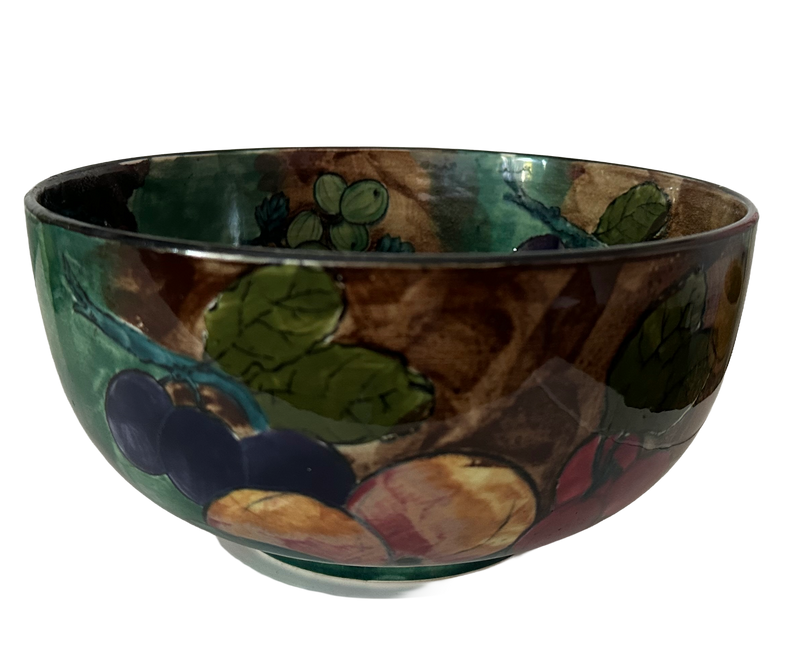
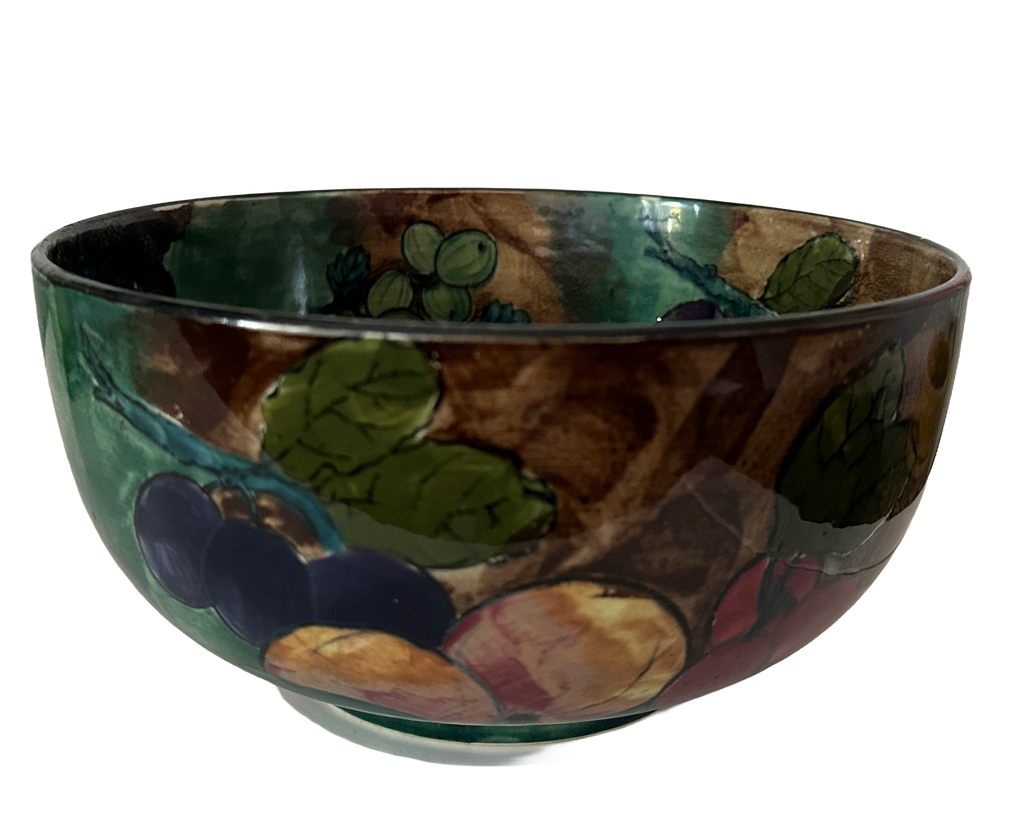
Περισσότερες πληροφορίες
{"id":10931529384095,"title":"S. Hancock \u0026 Sons Titian Ware Fruit Bowl, F. X. Abraham, 1930s","handle":"hancock-bowl","description":"\u003cp data-pm-slice=\"1 1 []\"\u003e\u003cspan\u003eThere is plenty to admire in this beautifully hand-painted Titian Ware fruit bowl, made by S. Hancock \u0026amp; Sons of Staffordshire in the late 1920s or 1930s. Deep and generously proportioned, it is decorated inside and out with clusters of grapes, plums and other fruit among broad green leaves. The colours are wonderfully rich, with deep greens, warm browns and earthy tones blending into a softly mottled background. It belongs to the firm's Titian Ware range, designed by F. X. Abraham.\u003c\/span\u003e\u003c\/p\u003e\n\u003cp\u003e\u003cspan\u003eS. Hancock \u0026amp; Sons had its roots in the Staffordshire pottery industry of the 19th century, but it was during the 1920s that the factory began producing some of its most distinctive decorative wares. Much of this change was associated with Francis Xavier Abraham, who had previously been art director at Copeland's Spode. At Hancock, he designed and introduced Titian Ware and Rubens Ware, two ranges that moved away from conventional tableware decoration towards something much more colourful and expressive.\u003c\/span\u003e\u003c\/p\u003e\n\u003cp\u003e\u003cspan\u003eTitian Ware was particularly suited to this approach. Rather than relying on neat, repeated patterns, the decoration made use of richly blended colours and hand-painted subjects, often drawn from fruit and nature. The results have a warmth and individuality that are quite different from the more formal dinner services of the period.\u003c\/span\u003e\u003c\/p\u003e\n\u003cp\u003e\u003cspan\u003eWhat I like about this bowl is that the decoration carries on into the interior, rather than stopping at the rim, as many pieces in this range do. The fruit and foliage seem to emerge from the dark green and brown background, and the hand-painted finish gives each part of the design a slightly different character. At 12 cm deep, it also has a substantial presence, making it as much a decorative bowl as a practical serving piece.\u003c\/span\u003e\u003c\/p\u003e\n\u003cp\u003e\u003cspan\u003eThe underside carries the printed \u003c\/span\u003e\u003cstrong\u003e\u003cspan\u003eTitian Ware, S. Hancock \u0026amp; Sons, Stoke-on-Trent, Hand Painted, F. X. Abraham \u003c\/span\u003e\u003c\/strong\u003e\u003cspan\u003emark, together with additional painted initials. \u003c\/span\u003e\u003c\/p\u003e\n\u003cp\u003e\u003cstrong\u003e\u003cspan\u003eDimensions:\u003c\/span\u003e\u003c\/strong\u003e\u003cspan\u003e 20.2 cm diameter, 12 cm high.\u003c\/span\u003e\u003c\/p\u003e\n\u003cp\u003e\u003cstrong\u003e\u003cspan\u003eCondition:\u003c\/span\u003e\u003c\/strong\u003e\u003cspan\u003e Very good vintage condition, with no chips or cracks. The colours remain rich and well preserved, with light age-related surface wear and some fine glaze crazing visible on the underside. Please see images.\u003c\/span\u003e\u003c\/p\u003e\n\u003cp\u003e\u003cstrong\u003e\u003cspan\u003eCollector's note:\u003c\/span\u003e\u003c\/strong\u003e\u003cspan\u003e British pottery of the 1920s and 1930s was not all about geometric Art Deco shapes. Factories such as Hancock were also experimenting with colour, hand-painted designs and less formal ways of decorating traditional pottery. Titian Ware is a lovely example of that development, and this bowl shows why the range remains appealing. It is a familiar fruit bowl in one sense, but the depth of colour and generous hand-painted decoration make it something rather more interesting.\u003c\/span\u003e\u003c\/p\u003e\n\u003cp\u003e\u003cstrong\u003e\u003cspan\u003eWorldwide Shipping:\u003c\/span\u003e\u003c\/strong\u003e\u003cspan\u003e We are always happy to ship worldwide. Your piece will be packed with great care and sent tracked.\u003c\/span\u003e\u003c\/p\u003e","published_at":"2026-11-09T05:49:23+00:00","created_at":"2026-08-31T09:47:26+01:00","vendor":"Eclectic Design ","type":"Decorative Bowl","tags":["Hand-Painted Pottery","S. Hancock \u0026 Sons","Staffordshire Pottery","Titian Ware","Vintage Fruit Bowl"],"price":6500,"price_min":6500,"price_max":6500,"available":true,"price_varies":false,"compare_at_price":null,"compare_at_price_min":0,"compare_at_price_max":0,"compare_at_price_varies":false,"variants":[{"id":62856723824799,"title":"Default Title","option1":"Default Title","option2":null,"option3":null,"sku":null,"requires_shipping":true,"taxable":true,"featured_image":null,"available":true,"name":"S. Hancock \u0026 Sons Titian Ware Fruit Bowl, F. X. Abraham, 1930s","public_title":null,"options":["Default Title"],"price":6500,"weight":2000,"compare_at_price":null,"inventory_quantity":1,"inventory_management":"shopify","inventory_policy":"deny","barcode":null,"requires_selling_plan":false,"selling_plan_allocations":[],"quantity_rule":{"min":1,"max":null,"increment":1}}],"images":["\/\/eclecticdesignlondon.com\/cdn\/shop\/files\/IMG_9990.png?v=1794201982","\/\/eclecticdesignlondon.com\/cdn\/shop\/files\/IMG_0017.png?v=1794165417","\/\/eclecticdesignlondon.com\/cdn\/shop\/files\/IMG_0014.png?v=1794165470","\/\/eclecticdesignlondon.com\/cdn\/shop\/files\/IMG_9986.png?v=1794165810","\/\/eclecticdesignlondon.com\/cdn\/shop\/files\/IMG_0011.png?v=1794165549","\/\/eclecticdesignlondon.com\/cdn\/shop\/files\/IMG_0009.png?v=1794201792","\/\/eclecticdesignlondon.com\/cdn\/shop\/files\/IMG_0002.png?v=1794201839","\/\/eclecticdesignlondon.com\/cdn\/shop\/files\/IMG_9987.png?v=1794165685","\/\/eclecticdesignlondon.com\/cdn\/shop\/files\/IMG_9998.png?v=1794201920","\/\/eclecticdesignlondon.com\/cdn\/shop\/files\/IMG_9994.png?v=1794201877"],"featured_image":"\/\/eclecticdesignlondon.com\/cdn\/shop\/files\/IMG_9990.png?v=1794201982","options":["Title"],"media":[{"alt":"Side view of the Titian Ware fruit bowl showing purple and yellow fruit with green leaves.","id":54654057939103,"position":1,"preview_image":{"aspect_ratio":1.237,"height":1912,"width":2365,"src":"\/\/eclecticdesignlondon.com\/cdn\/shop\/files\/IMG_9990.png?v=1794201982"},"aspect_ratio":1.237,"height":1912,"media_type":"image","src":"\/\/eclecticdesignlondon.com\/cdn\/shop\/files\/IMG_9990.png?v=1794201982","width":2365},{"alt":"Hancock \u0026 Sons Titian Ware fruit bowl with colourful fruit decoration on a green and brown ground.","id":54654057709727,"position":2,"preview_image":{"aspect_ratio":1.192,"height":2631,"width":3137,"src":"\/\/eclecticdesignlondon.com\/cdn\/shop\/files\/IMG_0017.png?v=1794165417"},"aspect_ratio":1.192,"height":2631,"media_type":"image","src":"\/\/eclecticdesignlondon.com\/cdn\/shop\/files\/IMG_0017.png?v=1794165417","width":3137},{"alt":"Angled view of the Titian Ware bowl showing purple grapes, yellow fruit and green foliage inside.","id":54654057742495,"position":3,"preview_image":{"aspect_ratio":1.324,"height":2568,"width":3401,"src":"\/\/eclecticdesignlondon.com\/cdn\/shop\/files\/IMG_0014.png?v=1794165470"},"aspect_ratio":1.324,"height":2568,"media_type":"image","src":"\/\/eclecticdesignlondon.com\/cdn\/shop\/files\/IMG_0014.png?v=1794165470","width":3401},{"alt":"Overhead view of the Titian Ware bowl showing fruit and foliage around the green and brown interior.","id":54654058004639,"position":4,"preview_image":{"aspect_ratio":0.999,"height":2203,"width":2201,"src":"\/\/eclecticdesignlondon.com\/cdn\/shop\/files\/IMG_9986.png?v=1794165810"},"aspect_ratio":0.999,"height":2203,"media_type":"image","src":"\/\/eclecticdesignlondon.com\/cdn\/shop\/files\/IMG_9986.png?v=1794165810","width":2201},{"alt":"Angled view of the Titian Ware bowl with green fruit, purple grapes and leafy decoration inside.","id":54654057775263,"position":5,"preview_image":{"aspect_ratio":1.259,"height":2612,"width":3288,"src":"\/\/eclecticdesignlondon.com\/cdn\/shop\/files\/IMG_0011.png?v=1794165549"},"aspect_ratio":1.259,"height":2612,"media_type":"image","src":"\/\/eclecticdesignlondon.com\/cdn\/shop\/files\/IMG_0011.png?v=1794165549","width":3288},{"alt":"Side view of the Titian Ware bowl showing its rounded shape, green glaze and colourful fruit decoration","id":54654057808031,"position":6,"preview_image":{"aspect_ratio":1.325,"height":2180,"width":2889,"src":"\/\/eclecticdesignlondon.com\/cdn\/shop\/files\/IMG_0009.png?v=1794201792"},"aspect_ratio":1.325,"height":2180,"media_type":"image","src":"\/\/eclecticdesignlondon.com\/cdn\/shop\/files\/IMG_0009.png?v=1794201792","width":2889},{"alt":"Interior view of the Titian Ware fruit bowl showing yellow fruit and purple grapes beneath a dark rim.","id":54654057840799,"position":7,"preview_image":{"aspect_ratio":1.331,"height":2000,"width":2661,"src":"\/\/eclecticdesignlondon.com\/cdn\/shop\/files\/IMG_0002.png?v=1794201839"},"aspect_ratio":1.331,"height":2000,"media_type":"image","src":"\/\/eclecticdesignlondon.com\/cdn\/shop\/files\/IMG_0002.png?v=1794201839","width":2661},{"alt":"Underside of the Titian Ware bowl showing the S. Hancock \u0026 Sons maker’s mark and F. X. Abraham signature.","id":54654057971871,"position":8,"preview_image":{"aspect_ratio":1.0,"height":2826,"width":2826,"src":"\/\/eclecticdesignlondon.com\/cdn\/shop\/files\/IMG_9987.png?v=1794165685"},"aspect_ratio":1.0,"height":2826,"media_type":"image","src":"\/\/eclecticdesignlondon.com\/cdn\/shop\/files\/IMG_9987.png?v=1794165685","width":2826},{"alt":"Front view of the Titian Ware bowl showing pale green fruit and leaves against a mottled green and brown ground.","id":54654057873567,"position":9,"preview_image":{"aspect_ratio":1.33,"height":1871,"width":2488,"src":"\/\/eclecticdesignlondon.com\/cdn\/shop\/files\/IMG_9998.png?v=1794201920"},"aspect_ratio":1.33,"height":1871,"media_type":"image","src":"\/\/eclecticdesignlondon.com\/cdn\/shop\/files\/IMG_9998.png?v=1794201920","width":2488},{"alt":"Side view of the Titian Ware bowl showing red and purple fruit, green leaves and a dark rim.","id":54654057906335,"position":10,"preview_image":{"aspect_ratio":1.33,"height":1926,"width":2562,"src":"\/\/eclecticdesignlondon.com\/cdn\/shop\/files\/IMG_9994.png?v=1794201877"},"aspect_ratio":1.33,"height":1926,"media_type":"image","src":"\/\/eclecticdesignlondon.com\/cdn\/shop\/files\/IMG_9994.png?v=1794201877","width":2562}],"requires_selling_plan":false,"selling_plan_groups":[],"content":"\u003cp data-pm-slice=\"1 1 []\"\u003e\u003cspan\u003eThere is plenty to admire in this beautifully hand-painted Titian Ware fruit bowl, made by S. Hancock \u0026amp; Sons of Staffordshire in the late 1920s or 1930s. Deep and generously proportioned, it is decorated inside and out with clusters of grapes, plums and other fruit among broad green leaves. The colours are wonderfully rich, with deep greens, warm browns and earthy tones blending into a softly mottled background. It belongs to the firm's Titian Ware range, designed by F. X. Abraham.\u003c\/span\u003e\u003c\/p\u003e\n\u003cp\u003e\u003cspan\u003eS. Hancock \u0026amp; Sons had its roots in the Staffordshire pottery industry of the 19th century, but it was during the 1920s that the factory began producing some of its most distinctive decorative wares. Much of this change was associated with Francis Xavier Abraham, who had previously been art director at Copeland's Spode. At Hancock, he designed and introduced Titian Ware and Rubens Ware, two ranges that moved away from conventional tableware decoration towards something much more colourful and expressive.\u003c\/span\u003e\u003c\/p\u003e\n\u003cp\u003e\u003cspan\u003eTitian Ware was particularly suited to this approach. Rather than relying on neat, repeated patterns, the decoration made use of richly blended colours and hand-painted subjects, often drawn from fruit and nature. The results have a warmth and individuality that are quite different from the more formal dinner services of the period.\u003c\/span\u003e\u003c\/p\u003e\n\u003cp\u003e\u003cspan\u003eWhat I like about this bowl is that the decoration carries on into the interior, rather than stopping at the rim, as many pieces in this range do. The fruit and foliage seem to emerge from the dark green and brown background, and the hand-painted finish gives each part of the design a slightly different character. At 12 cm deep, it also has a substantial presence, making it as much a decorative bowl as a practical serving piece.\u003c\/span\u003e\u003c\/p\u003e\n\u003cp\u003e\u003cspan\u003eThe underside carries the printed \u003c\/span\u003e\u003cstrong\u003e\u003cspan\u003eTitian Ware, S. Hancock \u0026amp; Sons, Stoke-on-Trent, Hand Painted, F. X. Abraham \u003c\/span\u003e\u003c\/strong\u003e\u003cspan\u003emark, together with additional painted initials. \u003c\/span\u003e\u003c\/p\u003e\n\u003cp\u003e\u003cstrong\u003e\u003cspan\u003eDimensions:\u003c\/span\u003e\u003c\/strong\u003e\u003cspan\u003e 20.2 cm diameter, 12 cm high.\u003c\/span\u003e\u003c\/p\u003e\n\u003cp\u003e\u003cstrong\u003e\u003cspan\u003eCondition:\u003c\/span\u003e\u003c\/strong\u003e\u003cspan\u003e Very good vintage condition, with no chips or cracks. The colours remain rich and well preserved, with light age-related surface wear and some fine glaze crazing visible on the underside. Please see images.\u003c\/span\u003e\u003c\/p\u003e\n\u003cp\u003e\u003cstrong\u003e\u003cspan\u003eCollector's note:\u003c\/span\u003e\u003c\/strong\u003e\u003cspan\u003e British pottery of the 1920s and 1930s was not all about geometric Art Deco shapes. Factories such as Hancock were also experimenting with colour, hand-painted designs and less formal ways of decorating traditional pottery. Titian Ware is a lovely example of that development, and this bowl shows why the range remains appealing. It is a familiar fruit bowl in one sense, but the depth of colour and generous hand-painted decoration make it something rather more interesting.\u003c\/span\u003e\u003c\/p\u003e\n\u003cp\u003e\u003cstrong\u003e\u003cspan\u003eWorldwide Shipping:\u003c\/span\u003e\u003c\/strong\u003e\u003cspan\u003e We are always happy to ship worldwide. Your piece will be packed with great care and sent tracked.\u003c\/span\u003e\u003c\/p\u003e"}
Side view of the Titian Ware fruit bowl showing purple and yellow fruit with green leaves.

S. Hancock & Sons Titian Ware Fruit Bowl, F. X. Abraham, 1930s

£65.00

There is plenty to admire in this beautifully hand-painted Titian Ware fruit bowl, made by S. Hancock & Sons of Staffordshire in the late 1920s or 1930s. Deep and generously proportioned, it is decorated inside and out with clusters of grapes, plums and other fruit among broad green leaves. The colours are wonderfully rich, with deep greens,...

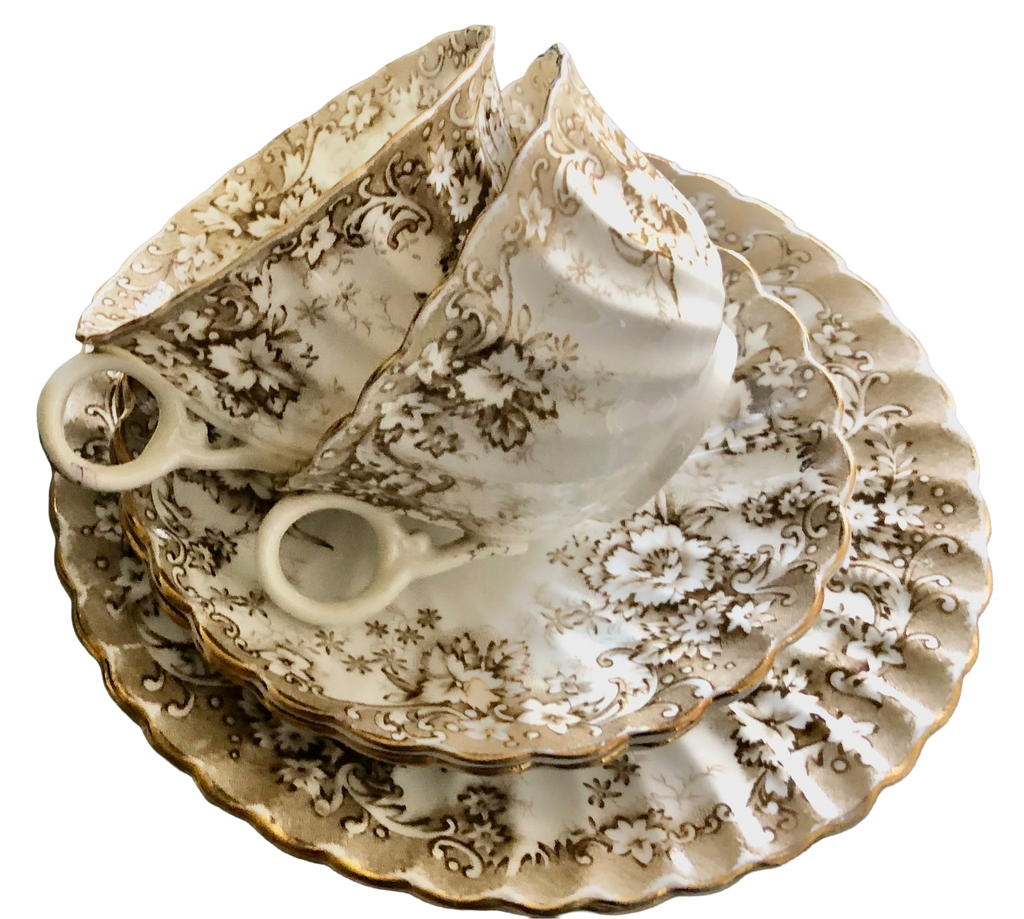
Περισσότερες πληροφορίες
{"id":10944189071519,"title":"Antique David Chapman \u0026 Sons Bone China Tea Set for Two with Slop Bowl, c.1897","handle":"chapman-tea-set","description":"\u003cp\u003e\u003cimg\u003e\u003cimg\u003e\u003cspan\u003eMade for tea for two, this late-Victorian service has survived with its matching slop bowl—a part of the formal tea table that is now far less familiar.\u003c\/span\u003e\u003c\/p\u003e\n\u003cp\u003e\u003cspan\u003eMade by David Chapman \u0026amp; Sons at the Atlas Works, the seven-piece bone china service comprises two teacups, two saucers, two side plates and a matching slop or waste bowl.\u003c\/span\u003e\u003c\/p\u003e\n\u003cp\u003e\u003cspan\u003eThe sepia-brown floral transfer is unusually detailed, combining scrolling foliage, white floral reserves and fine gilt edging. Spiral fluting runs through each piece, finishing at scalloped rims. The circular ring handles are especially distinctive and give the cups a strong profile when set on the table.\u003c\/span\u003e\u003c\/p\u003e\n\u003cp\u003e\u003cspan\u003eThe slop bowl was used for emptying cold tea and spent leaves before a fresh cup was poured. Its decoration continues around the deep fluted body and across the inner rim, tying it closely to the two trios.\u003c\/span\u003e\u003c\/p\u003e\n\u003cp\u003e\u003cspan\u003eThe Chapman backstamp incorporates Atlas carrying the globe, referring to the company’s Atlas Works. Registered Design No. 300213 dates the design to 1897. The red hand-painted factory number identifies pattern 2387.\u003c\/span\u003e\u003c\/p\u003e\n\u003cp\u003e\u003cstrong\u003e\u003cspan\u003eThe set comprises:\u003c\/span\u003e\u003c\/strong\u003e\u003c\/p\u003e\n\u003cul data-spread=\"false\"\u003e\n\u003cli\u003e\n\u003cp\u003e\u003cspan\u003eTwo teacups\u003c\/span\u003e\u003c\/p\u003e\n\u003c\/li\u003e\n\u003cli\u003e\n\u003cp\u003e\u003cspan\u003eTwo saucers\u003c\/span\u003e\u003c\/p\u003e\n\u003c\/li\u003e\n\u003cli\u003e\n\u003cp\u003e\u003cspan\u003eTwo side plates\u003c\/span\u003e\u003c\/p\u003e\n\u003c\/li\u003e\n\u003cli\u003e\n\u003cp\u003e\u003cspan\u003eOne matching slop bowl\u003c\/span\u003e\u003c\/p\u003e\n\u003c\/li\u003e\n\u003c\/ul\u003e\n\u003cp\u003e\u003cstrong\u003e\u003cspan\u003eMaker:\u003c\/span\u003e\u003c\/strong\u003e\u003cspan\u003e David Chapman \u0026amp; Sons\u003c\/span\u003e\u003cbr\u003e\u003cstrong\u003e\u003cspan\u003eFactory:\u003c\/span\u003e\u003c\/strong\u003e\u003cspan\u003e Atlas Works, Staffordshire, England\u003c\/span\u003e\u003cbr\u003e\u003cstrong\u003e\u003cspan\u003eDate:\u003c\/span\u003e\u003c\/strong\u003e\u003cspan\u003e c.1897–1905\u003c\/span\u003e\u003cbr\u003e\u003cstrong\u003e\u003cspan\u003ePattern:\u003c\/span\u003e\u003c\/strong\u003e\u003cspan\u003e 2387\u003c\/span\u003e\u003cbr\u003e\u003cstrong\u003e\u003cspan\u003eRegistered Design:\u003c\/span\u003e\u003c\/strong\u003e\u003cspan\u003e No. 300213\u003c\/span\u003e\u003cbr\u003e\u003cstrong\u003e\u003cspan\u003eMaterial:\u003c\/span\u003e\u003c\/strong\u003e\u003cspan\u003e English bone china\u003c\/span\u003e\u003cbr\u003e\u003cstrong\u003e\u003cspan\u003eCondition:\u003c\/span\u003e\u003c\/strong\u003e\u003cspan\u003e Good antique condition, with  some rubbing to the gilded rims and light surface wear consistent with age. Please study the photographs carefully.\u003c\/span\u003e\u003c\/p\u003e\n\u003cp\u003e\u003cstrong\u003e\u003cspan\u003eCollector’s Note\u003c\/span\u003e\u003c\/strong\u003e\u003c\/p\u003e\n\u003cp\u003e\u003cspan\u003eRegistered Design No. 300213 was issued in 1897 and dates the design rather than the precise manufacture of each piece. The Chapman and Atlas backstamp was used by David Chapman \u0026amp; Sons during the late nineteenth and early twentieth centuries. The company became Atlas China Co. in 1905 and should not be confused with Chapman’s (Longton) Ltd, a separate business established in 1916.\u003c\/span\u003e\u003c\/p\u003e\n\u003cp\u003e\u003cspan\u003eWORLDWIDE SHIPPING available. All our items are packed carefully for transit. Please message for additional photographs or delivery information.\u003c\/span\u003e\u003c\/p\u003e","published_at":"2026-11-15T18:13:21+00:00","created_at":"2026-11-15T13:40:20+00:00","vendor":"Eclectic Design ","type":"Tea Service","tags":["Bone China","David Chapman \u0026 Sons","Slop Bowl","Tea for Two","Victorian Tea Set"],"price":6500,"price_min":6500,"price_max":6500,"available":true,"price_varies":false,"compare_at_price":null,"compare_at_price_min":0,"compare_at_price_max":0,"compare_at_price_varies":false,"variants":[{"id":62909175759007,"title":"Default Title","option1":"Default Title","option2":null,"option3":null,"sku":null,"requires_shipping":true,"taxable":true,"featured_image":null,"available":true,"name":"Antique David Chapman \u0026 Sons Bone China Tea Set for Two with Slop Bowl, c.1897","public_title":null,"options":["Default Title"],"price":6500,"weight":3000,"compare_at_price":null,"inventory_quantity":1,"inventory_management":"shopify","inventory_policy":"deny","barcode":null,"requires_selling_plan":false,"selling_plan_allocations":[],"quantity_rule":{"min":1,"max":null,"increment":1}}],"images":["\/\/eclecticdesignlondon.com\/cdn\/shop\/files\/IMG_5942.png?v=1794763426","\/\/eclecticdesignlondon.com\/cdn\/shop\/files\/IMG_5932.png?v=1794765007","\/\/eclecticdesignlondon.com\/cdn\/shop\/files\/IMG_5933_bac4d236-4e35-4364-8fa8-c28d3b48ac6a.jpg?v=1794764912","\/\/eclecticdesignlondon.com\/cdn\/shop\/files\/IMG_5929.png?v=1794763592","\/\/eclecticdesignlondon.com\/cdn\/shop\/files\/IMG_5940.png?v=1794765200","\/\/eclecticdesignlondon.com\/cdn\/shop\/files\/IMG_5942_e96f0623-096e-48aa-ba22-b5bce094151a.png?v=1794763379","\/\/eclecticdesignlondon.com\/cdn\/shop\/files\/IMG_5943.png?v=1794764033","\/\/eclecticdesignlondon.com\/cdn\/shop\/files\/IMG_5934_de9fe544-5700-497a-b926-9de91a226edf.jpg?v=1794764888","\/\/eclecticdesignlondon.com\/cdn\/shop\/files\/IMG_5935_d7112480-24ab-462c-9ea1-56609bfdbe34.jpg?v=1794764909","\/\/eclecticdesignlondon.com\/cdn\/shop\/files\/IMG_5941.png?v=1794763381","\/\/eclecticdesignlondon.com\/cdn\/shop\/files\/IMG_5928.png?v=1794763531","\/\/eclecticdesignlondon.com\/cdn\/shop\/files\/IMG_5930.png?v=1794763664"],"featured_image":"\/\/eclecticdesignlondon.com\/cdn\/shop\/files\/IMG_5942.png?v=1794763426","options":["Title"],"media":[{"alt":"wo David Chapman bone china teacups on matching saucers and side plates, with sepia floral decoration and gilt rims.","id":54663354974367,"position":1,"preview_image":{"aspect_ratio":1.114,"height":2028,"width":2260,"src":"\/\/eclecticdesignlondon.com\/cdn\/shop\/files\/IMG_5942.png?v=1794763426"},"aspect_ratio":1.114,"height":2028,"media_type":"image","src":"\/\/eclecticdesignlondon.com\/cdn\/shop\/files\/IMG_5942.png?v=1794763426","width":2260},{"alt":"Chapman bone china teacup on stacked matching saucers and plates, showing its floral interior and circular ring handle.","id":54663355269279,"position":2,"preview_image":{"aspect_ratio":1.34,"height":1857,"width":2489,"src":"\/\/eclecticdesignlondon.com\/cdn\/shop\/files\/IMG_5932.png?v=1794765007"},"aspect_ratio":1.34,"height":1857,"media_type":"image","src":"\/\/eclecticdesignlondon.com\/cdn\/shop\/files\/IMG_5932.png?v=1794765007","width":2489},{"alt":"Overhead view of a Chapman teacup, saucer and side plate with sepia floral borders and scalloped gilt rims.","id":54663358709919,"position":3,"preview_image":{"aspect_ratio":1.0,"height":2532,"width":2532,"src":"\/\/eclecticdesignlondon.com\/cdn\/shop\/files\/IMG_5933_bac4d236-4e35-4364-8fa8-c28d3b48ac6a.jpg?v=1794764912"},"aspect_ratio":1.0,"height":2532,"media_type":"image","src":"\/\/eclecticdesignlondon.com\/cdn\/shop\/files\/IMG_5933_bac4d236-4e35-4364-8fa8-c28d3b48ac6a.jpg?v=1794764912","width":2532},{"alt":"Underside of a Chapman teacup showing the England backstamp, registered design number 300213 and red pattern number 2387..","id":54663355203743,"position":4,"preview_image":{"aspect_ratio":0.908,"height":3024,"width":2745,"src":"\/\/eclecticdesignlondon.com\/cdn\/shop\/files\/IMG_5929.png?v=1794763592"},"aspect_ratio":0.908,"height":3024,"media_type":"image","src":"\/\/eclecticdesignlondon.com\/cdn\/shop\/files\/IMG_5929.png?v=1794763592","width":2745},{"alt":"Victorian Chapman tea set for two with matching slop bowl, fluted cups, saucers and side plates in sepia floral bone china.","id":54663355400351,"position":5,"preview_image":{"aspect_ratio":1.395,"height":2615,"width":3647,"src":"\/\/eclecticdesignlondon.com\/cdn\/shop\/files\/IMG_5940.png?v=1794765200"},"aspect_ratio":1.395,"height":2615,"media_type":"image","src":"\/\/eclecticdesignlondon.com\/cdn\/shop\/files\/IMG_5940.png?v=1794765200","width":3647},{"alt":"Close-up of two Chapman teacups with circular ring handles, spiral fluting and matching floral saucers and side plates.","id":54663355465887,"position":6,"preview_image":{"aspect_ratio":0.98,"height":2306,"width":2260,"src":"\/\/eclecticdesignlondon.com\/cdn\/shop\/files\/IMG_5942_e96f0623-096e-48aa-ba22-b5bce094151a.png?v=1794763379"},"aspect_ratio":0.98,"height":2306,"media_type":"image","src":"\/\/eclecticdesignlondon.com\/cdn\/shop\/files\/IMG_5942_e96f0623-096e-48aa-ba22-b5bce094151a.png?v=1794763379","width":2260},{"alt":"Overhead view of the Chapman tea service showing the slop bowl interior beside two cups and stacked saucers and plates.","id":54663355498655,"position":7,"preview_image":{"aspect_ratio":1.296,"height":2375,"width":3078,"src":"\/\/eclecticdesignlondon.com\/cdn\/shop\/files\/IMG_5943.png?v=1794764033"},"aspect_ratio":1.296,"height":2375,"media_type":"image","src":"\/\/eclecticdesignlondon.com\/cdn\/shop\/files\/IMG_5943.png?v=1794764033","width":3078},{"alt":"Chapman bone china saucer on a matching side plate, showing sepia floral transfers, spiral fluting and scalloped gilt edges.","id":54663358611615,"position":8,"preview_image":{"aspect_ratio":1.0,"height":2601,"width":2601,"src":"\/\/eclecticdesignlondon.com\/cdn\/shop\/files\/IMG_5934_de9fe544-5700-497a-b926-9de91a226edf.jpg?v=1794764888"},"aspect_ratio":1.0,"height":2601,"media_type":"image","src":"\/\/eclecticdesignlondon.com\/cdn\/shop\/files\/IMG_5934_de9fe544-5700-497a-b926-9de91a226edf.jpg?v=1794764888","width":2601},{"alt":"Chapman bone china side plate with a sepia floral border, spiral-fluted surface and scalloped gilt rim.","id":54663358677151,"position":9,"preview_image":{"aspect_ratio":1.0,"height":2801,"width":2801,"src":"\/\/eclecticdesignlondon.com\/cdn\/shop\/files\/IMG_5935_d7112480-24ab-462c-9ea1-56609bfdbe34.jpg?v=1794764909"},"aspect_ratio":1.0,"height":2801,"media_type":"image","src":"\/\/eclecticdesignlondon.com\/cdn\/shop\/files\/IMG_5935_d7112480-24ab-462c-9ea1-56609bfdbe34.jpg?v=1794764909","width":2801},{"alt":"Side view of the Chapman tea service with its matching slop bowl, ring-handled cups and stacked floral plates.","id":54663355433119,"position":10,"preview_image":{"aspect_ratio":1.333,"height":3024,"width":4032,"src":"\/\/eclecticdesignlondon.com\/cdn\/shop\/files\/IMG_5941.png?v=1794763381"},"aspect_ratio":1.333,"height":3024,"media_type":"image","src":"\/\/eclecticdesignlondon.com\/cdn\/shop\/files\/IMG_5941.png?v=1794763381","width":4032},{"alt":"Angled view of the Chapman slop bowl beside two nested teacups on matching sepia floral saucers and side plates.","id":54663355170975,"position":11,"preview_image":{"aspect_ratio":0.94,"height":3120,"width":2933,"src":"\/\/eclecticdesignlondon.com\/cdn\/shop\/files\/IMG_5928.png?v=1794763531"},"aspect_ratio":0.94,"height":3120,"media_type":"image","src":"\/\/eclecticdesignlondon.com\/cdn\/shop\/files\/IMG_5928.png?v=1794763531","width":2933},{"alt":"Chapman teacup turned over on matching plates to show its factory backstamp, with the slop bowl alongside.","id":54663355236511,"position":12,"preview_image":{"aspect_ratio":0.84,"height":3162,"width":2657,"src":"\/\/eclecticdesignlondon.com\/cdn\/shop\/files\/IMG_5930.png?v=1794763664"},"aspect_ratio":0.84,"height":3162,"media_type":"image","src":"\/\/eclecticdesignlondon.com\/cdn\/shop\/files\/IMG_5930.png?v=1794763664","width":2657}],"requires_selling_plan":false,"selling_plan_groups":[],"content":"\u003cp\u003e\u003cimg\u003e\u003cimg\u003e\u003cspan\u003eMade for tea for two, this late-Victorian service has survived with its matching slop bowl—a part of the formal tea table that is now far less familiar.\u003c\/span\u003e\u003c\/p\u003e\n\u003cp\u003e\u003cspan\u003eMade by David Chapman \u0026amp; Sons at the Atlas Works, the seven-piece bone china service comprises two teacups, two saucers, two side plates and a matching slop or waste bowl.\u003c\/span\u003e\u003c\/p\u003e\n\u003cp\u003e\u003cspan\u003eThe sepia-brown floral transfer is unusually detailed, combining scrolling foliage, white floral reserves and fine gilt edging. Spiral fluting runs through each piece, finishing at scalloped rims. The circular ring handles are especially distinctive and give the cups a strong profile when set on the table.\u003c\/span\u003e\u003c\/p\u003e\n\u003cp\u003e\u003cspan\u003eThe slop bowl was used for emptying cold tea and spent leaves before a fresh cup was poured. Its decoration continues around the deep fluted body and across the inner rim, tying it closely to the two trios.\u003c\/span\u003e\u003c\/p\u003e\n\u003cp\u003e\u003cspan\u003eThe Chapman backstamp incorporates Atlas carrying the globe, referring to the company’s Atlas Works. Registered Design No. 300213 dates the design to 1897. The red hand-painted factory number identifies pattern 2387.\u003c\/span\u003e\u003c\/p\u003e\n\u003cp\u003e\u003cstrong\u003e\u003cspan\u003eThe set comprises:\u003c\/span\u003e\u003c\/strong\u003e\u003c\/p\u003e\n\u003cul data-spread=\"false\"\u003e\n\u003cli\u003e\n\u003cp\u003e\u003cspan\u003eTwo teacups\u003c\/span\u003e\u003c\/p\u003e\n\u003c\/li\u003e\n\u003cli\u003e\n\u003cp\u003e\u003cspan\u003eTwo saucers\u003c\/span\u003e\u003c\/p\u003e\n\u003c\/li\u003e\n\u003cli\u003e\n\u003cp\u003e\u003cspan\u003eTwo side plates\u003c\/span\u003e\u003c\/p\u003e\n\u003c\/li\u003e\n\u003cli\u003e\n\u003cp\u003e\u003cspan\u003eOne matching slop bowl\u003c\/span\u003e\u003c\/p\u003e\n\u003c\/li\u003e\n\u003c\/ul\u003e\n\u003cp\u003e\u003cstrong\u003e\u003cspan\u003eMaker:\u003c\/span\u003e\u003c\/strong\u003e\u003cspan\u003e David Chapman \u0026amp; Sons\u003c\/span\u003e\u003cbr\u003e\u003cstrong\u003e\u003cspan\u003eFactory:\u003c\/span\u003e\u003c\/strong\u003e\u003cspan\u003e Atlas Works, Staffordshire, England\u003c\/span\u003e\u003cbr\u003e\u003cstrong\u003e\u003cspan\u003eDate:\u003c\/span\u003e\u003c\/strong\u003e\u003cspan\u003e c.1897–1905\u003c\/span\u003e\u003cbr\u003e\u003cstrong\u003e\u003cspan\u003ePattern:\u003c\/span\u003e\u003c\/strong\u003e\u003cspan\u003e 2387\u003c\/span\u003e\u003cbr\u003e\u003cstrong\u003e\u003cspan\u003eRegistered Design:\u003c\/span\u003e\u003c\/strong\u003e\u003cspan\u003e No. 300213\u003c\/span\u003e\u003cbr\u003e\u003cstrong\u003e\u003cspan\u003eMaterial:\u003c\/span\u003e\u003c\/strong\u003e\u003cspan\u003e English bone china\u003c\/span\u003e\u003cbr\u003e\u003cstrong\u003e\u003cspan\u003eCondition:\u003c\/span\u003e\u003c\/strong\u003e\u003cspan\u003e Good antique condition, with  some rubbing to the gilded rims and light surface wear consistent with age. Please study the photographs carefully.\u003c\/span\u003e\u003c\/p\u003e\n\u003cp\u003e\u003cstrong\u003e\u003cspan\u003eCollector’s Note\u003c\/span\u003e\u003c\/strong\u003e\u003c\/p\u003e\n\u003cp\u003e\u003cspan\u003eRegistered Design No. 300213 was issued in 1897 and dates the design rather than the precise manufacture of each piece. The Chapman and Atlas backstamp was used by David Chapman \u0026amp; Sons during the late nineteenth and early twentieth centuries. The company became Atlas China Co. in 1905 and should not be confused with Chapman’s (Longton) Ltd, a separate business established in 1916.\u003c\/span\u003e\u003c\/p\u003e\n\u003cp\u003e\u003cspan\u003eWORLDWIDE SHIPPING available. All our items are packed carefully for transit. Please message for additional photographs or delivery information.\u003c\/span\u003e\u003c\/p\u003e"}
wo David Chapman bone china teacups on matching saucers and side plates, with sepia floral decoration and gilt rims.

Antique David Chapman & Sons Bone China Tea Set for Two with Slop Bowl, c.1897

£65.00

Made for tea for two, this late-Victorian service has survived with its matching slop bowl—a part of the formal tea table that is now far less familiar. Made by David Chapman & Sons at the Atlas Works, the seven-piece bone china service comprises two teacups, two saucers, two side plates and a matching slop or waste bowl. The sepia-brown flo...


Περισσότερες πληροφορίες
{"id":10944188940447,"title":"Antique Coalport Green Dragon Bone China Tea Service with Rare Bamboo Handles, Pattern 4322, c.1891–1920","handle":"antique-green-dragon-tea-set","description":"\u003cp\u003e\u003cimg\u003e\u003cspan\u003eThis is more than a beautiful survivor. It brings together two important chapters of English design: the eighteenth-century fascination with Chinese porcelain and the late Victorian passion for Japonisme.\u003c\/span\u003e\u003c\/p\u003e\n\u003cp\u003e\u003cspan\u003eThe dragons belong to the historic Broseley Dragon tradition, a Chinese-derived pattern first produced at Caughley in Shropshire during the 1780s and later continued by Coalport. Here, the design has been reworked in one wonderfully clear green, combining dragons and phoenixes with rare bamboo-form handles.\u003c\/span\u003e\u003c\/p\u003e\n\u003cp\u003e\u003cspan\u003eThose handles are not merely an attractive finishing detail. Their segmented rings, painted in alternating green and white bands, reflect the late nineteenth-century fashion for bamboo and Japanese-inspired form. They carry the East Asian influence beyond the decoration and into the shape of the service itself.\u003c\/span\u003e\u003c\/p\u003e\n\u003cp\u003e\u003cspan\u003eThe single green against white bone china allows the dragons, phoenixes and Chinese emblems to remain intricate without appearing heavy. A single cup shows the pattern; the complete service reveals the design. Laid for four, dragons circle every place setting, phoenix medallions anchor the larger plates and the striped handles repeat around the table as a series of green-and-white rings.\u003c\/span\u003e\u003c\/p\u003e\n\u003cp\u003e\u003cspan\u003eThis was made when taking tea meant laying a proper table. The jug, sugar bowl and cake plate were not optional additions but part of the occasion, designed to be brought out and used together. Unlike a solitary display cup, this service can still do exactly what it was made to do more than 100 years ago.\u003c\/span\u003e\u003c\/p\u003e\n\u003cp\u003e\u003cspan\u003eThat fifteen matching pieces—and all five of the distinctive bamboo handles—have remained together for over a century makes this an exceptional survival.\u003c\/span\u003e\u003c\/p\u003e\n\u003cp\u003e\u003cspan\u003eThe service comprises four cups, four saucers, four side plates, a cake plate, an open sugar bowl and a cream jug.\u003c\/span\u003e\u003c\/p\u003e\n\u003cp\u003e\u003cspan\u003eEach piece carries the Coalport crown backstamp with \u003c\/span\u003e\u003cstrong\u003e\u003cspan\u003eENGLAND\u003c\/span\u003e\u003c\/strong\u003e\u003cspan\u003e, \u003c\/span\u003e\u003cstrong\u003e\u003cspan\u003eCOALPORT\u003c\/span\u003e\u003c\/strong\u003e\u003cspan\u003e and \u003c\/span\u003e\u003cstrong\u003e\u003cspan\u003eA.D. 1750\u003c\/span\u003e\u003c\/strong\u003e\u003cspan\u003e, together with the factory pattern number \u003c\/span\u003e\u003cstrong\u003e\u003cspan\u003e4322\u003c\/span\u003e\u003c\/strong\u003e\u003cspan\u003e, painted by hand in red.\u003c\/span\u003e\u003c\/p\u003e\n\u003cp\u003e\u003cstrong\u003e\u003cspan\u003eMaker:\u003c\/span\u003e\u003c\/strong\u003e\u003cspan\u003e Coalport\u003c\/span\u003e\u003cbr\u003e\u003cstrong\u003e\u003cspan\u003ePattern:\u003c\/span\u003e\u003c\/strong\u003e\u003cspan\u003e Green Dragon, factory pattern 4322\u003c\/span\u003e\u003cbr\u003e\u003cstrong\u003e\u003cspan\u003eDate:\u003c\/span\u003e\u003c\/strong\u003e\u003cspan\u003e c.1891–1919\u003c\/span\u003e\u003cbr\u003e\u003cstrong\u003e\u003cspan\u003eOrigin:\u003c\/span\u003e\u003c\/strong\u003e\u003cspan\u003e England\u003c\/span\u003e\u003cbr\u003e\u003cstrong\u003e\u003cspan\u003eMaterial:\u003c\/span\u003e\u003c\/strong\u003e\u003cspan\u003e Bone china\u003c\/span\u003e\u003cbr\u003e\u003cstrong\u003e\u003cspan\u003eNumber of pieces:\u003c\/span\u003e\u003c\/strong\u003e\u003cspan\u003e 15\u003c\/span\u003e\u003cbr\u003e\u003cstrong\u003e\u003cspan\u003eCondition:\u003c\/span\u003e\u003c\/strong\u003e\u003cspan\u003e Good antique condition with light surface wear and some rubbing to the green decoration consistent with age and use. Please study all photographs carefully.\u003c\/span\u003e\u003c\/p\u003e\n\u003cp\u003e\u003cstrong\u003e\u003cspan\u003eCollector’s Note\u003c\/span\u003e\u003c\/strong\u003e\u003c\/p\u003e\n\u003cp\u003e\u003cspan\u003eThe Coalport crown backstamp with “England” dates this service to approximately 1891–1919. The A.D. 1750 inscription refers to Coalport’s claimed connection with the earlier Caughley porcelain works and is not the date of manufacture.\u003c\/span\u003e\u003c\/p\u003e\n\u003cp\u003e\u003cspan\u003eWORLDWIDE SHIPPING available. All our items are packed carefully for transit. Please message for additional photographs or delivery information.\u003c\/span\u003e\u003c\/p\u003e","published_at":"2026-11-15T20:16:15+00:00","created_at":"2026-11-15T13:35:13+00:00","vendor":"Eclectic Design ","type":"Tea Service","tags":["Antique Tea Service","Bamboo Handles","Bone China","Coalport","Green Dragon"],"price":29000,"price_min":29000,"price_max":29000,"available":true,"price_varies":false,"compare_at_price":null,"compare_at_price_min":0,"compare_at_price_max":0,"compare_at_price_varies":false,"variants":[{"id":62909175627935,"title":"Default Title","option1":"Default Title","option2":null,"option3":null,"sku":null,"requires_shipping":true,"taxable":true,"featured_image":null,"available":true,"name":"Antique Coalport Green Dragon Bone China Tea Service with Rare Bamboo Handles, Pattern 4322, c.1891–1920","public_title":null,"options":["Default Title"],"price":29000,"weight":4000,"compare_at_price":null,"inventory_quantity":1,"inventory_management":"shopify","inventory_policy":"deny","barcode":null,"requires_selling_plan":false,"selling_plan_allocations":[],"quantity_rule":{"min":1,"max":null,"increment":1}}],"images":["\/\/eclecticdesignlondon.com\/cdn\/shop\/files\/IMG_1156.png?v=1794772940","\/\/eclecticdesignlondon.com\/cdn\/shop\/files\/IMG_1157.png?v=1794773053","\/\/eclecticdesignlondon.com\/cdn\/shop\/files\/IMG_8531.png?v=1794772981","\/\/eclecticdesignlondon.com\/cdn\/shop\/files\/IMG_1153-2.png?v=1794772851","\/\/eclecticdesignlondon.com\/cdn\/shop\/files\/IMG_1154.png?v=1794772850"],"featured_image":"\/\/eclecticdesignlondon.com\/cdn\/shop\/files\/IMG_1156.png?v=1794772940","options":["Title"],"media":[{"alt":"Antique Coalport Green Dragon bone china tea service with cups, saucers, plates, sugar bowl and bamboo-handled cre","id":54663378272415,"position":1,"preview_image":{"aspect_ratio":1.094,"height":2743,"width":3002,"src":"\/\/eclecticdesignlondon.com\/cdn\/shop\/files\/IMG_1156.png?v=1794772940"},"aspect_ratio":1.094,"height":2743,"media_type":"image","src":"\/\/eclecticdesignlondon.com\/cdn\/shop\/files\/IMG_1156.png?v=1794772940","width":3002},{"alt":"Coalport Green Dragon tea service arranged with stacked saucers and plates, matching cups, sugar bowl and cream jug.","id":54663378337951,"position":2,"preview_image":{"aspect_ratio":1.135,"height":2627,"width":2981,"src":"\/\/eclecticdesignlondon.com\/cdn\/shop\/files\/IMG_1157.png?v=1794773053"},"aspect_ratio":1.135,"height":2627,"media_type":"image","src":"\/\/eclecticdesignlondon.com\/cdn\/shop\/files\/IMG_1157.png?v=1794773053","width":2981},{"alt":"Coalport bone china cream jug with green phoenix decoration, scalloped rim and green-striped bamboo-form handle.","id":54663378206879,"position":3,"preview_image":{"aspect_ratio":1.184,"height":2671,"width":3163,"src":"\/\/eclecticdesignlondon.com\/cdn\/shop\/files\/IMG_8531.png?v=1794772981"},"aspect_ratio":1.184,"height":2671,"media_type":"image","src":"\/\/eclecticdesignlondon.com\/cdn\/shop\/files\/IMG_8531.png?v=1794772981","width":3163},{"alt":"Coalport Green Dragon tea set showing green dragon and phoenix motifs on white bone china with bamboo-form cup handles.","id":54663378239647,"position":4,"preview_image":{"aspect_ratio":1.058,"height":2898,"width":3066,"src":"\/\/eclecticdesignlondon.com\/cdn\/shop\/files\/IMG_1153-2.png?v=1794772851"},"aspect_ratio":1.058,"height":2898,"media_type":"image","src":"\/\/eclecticdesignlondon.com\/cdn\/shop\/files\/IMG_1153-2.png?v=1794772851","width":3066},{"alt":"Underside of a Coalport teacup showing the green crown backstamp, England and A.D. 1750 lettering, and red pattern number 4322.","id":54663378305183,"position":5,"preview_image":{"aspect_ratio":0.969,"height":1969,"width":1908,"src":"\/\/eclecticdesignlondon.com\/cdn\/shop\/files\/IMG_1154.png?v=1794772850"},"aspect_ratio":0.969,"height":1969,"media_type":"image","src":"\/\/eclecticdesignlondon.com\/cdn\/shop\/files\/IMG_1154.png?v=1794772850","width":1908}],"requires_selling_plan":false,"selling_plan_groups":[],"content":"\u003cp\u003e\u003cimg\u003e\u003cspan\u003eThis is more than a beautiful survivor. It brings together two important chapters of English design: the eighteenth-century fascination with Chinese porcelain and the late Victorian passion for Japonisme.\u003c\/span\u003e\u003c\/p\u003e\n\u003cp\u003e\u003cspan\u003eThe dragons belong to the historic Broseley Dragon tradition, a Chinese-derived pattern first produced at Caughley in Shropshire during the 1780s and later continued by Coalport. Here, the design has been reworked in one wonderfully clear green, combining dragons and phoenixes with rare bamboo-form handles.\u003c\/span\u003e\u003c\/p\u003e\n\u003cp\u003e\u003cspan\u003eThose handles are not merely an attractive finishing detail. Their segmented rings, painted in alternating green and white bands, reflect the late nineteenth-century fashion for bamboo and Japanese-inspired form. They carry the East Asian influence beyond the decoration and into the shape of the service itself.\u003c\/span\u003e\u003c\/p\u003e\n\u003cp\u003e\u003cspan\u003eThe single green against white bone china allows the dragons, phoenixes and Chinese emblems to remain intricate without appearing heavy. A single cup shows the pattern; the complete service reveals the design. Laid for four, dragons circle every place setting, phoenix medallions anchor the larger plates and the striped handles repeat around the table as a series of green-and-white rings.\u003c\/span\u003e\u003c\/p\u003e\n\u003cp\u003e\u003cspan\u003eThis was made when taking tea meant laying a proper table. The jug, sugar bowl and cake plate were not optional additions but part of the occasion, designed to be brought out and used together. Unlike a solitary display cup, this service can still do exactly what it was made to do more than 100 years ago.\u003c\/span\u003e\u003c\/p\u003e\n\u003cp\u003e\u003cspan\u003eThat fifteen matching pieces—and all five of the distinctive bamboo handles—have remained together for over a century makes this an exceptional survival.\u003c\/span\u003e\u003c\/p\u003e\n\u003cp\u003e\u003cspan\u003eThe service comprises four cups, four saucers, four side plates, a cake plate, an open sugar bowl and a cream jug.\u003c\/span\u003e\u003c\/p\u003e\n\u003cp\u003e\u003cspan\u003eEach piece carries the Coalport crown backstamp with \u003c\/span\u003e\u003cstrong\u003e\u003cspan\u003eENGLAND\u003c\/span\u003e\u003c\/strong\u003e\u003cspan\u003e, \u003c\/span\u003e\u003cstrong\u003e\u003cspan\u003eCOALPORT\u003c\/span\u003e\u003c\/strong\u003e\u003cspan\u003e and \u003c\/span\u003e\u003cstrong\u003e\u003cspan\u003eA.D. 1750\u003c\/span\u003e\u003c\/strong\u003e\u003cspan\u003e, together with the factory pattern number \u003c\/span\u003e\u003cstrong\u003e\u003cspan\u003e4322\u003c\/span\u003e\u003c\/strong\u003e\u003cspan\u003e, painted by hand in red.\u003c\/span\u003e\u003c\/p\u003e\n\u003cp\u003e\u003cstrong\u003e\u003cspan\u003eMaker:\u003c\/span\u003e\u003c\/strong\u003e\u003cspan\u003e Coalport\u003c\/span\u003e\u003cbr\u003e\u003cstrong\u003e\u003cspan\u003ePattern:\u003c\/span\u003e\u003c\/strong\u003e\u003cspan\u003e Green Dragon, factory pattern 4322\u003c\/span\u003e\u003cbr\u003e\u003cstrong\u003e\u003cspan\u003eDate:\u003c\/span\u003e\u003c\/strong\u003e\u003cspan\u003e c.1891–1919\u003c\/span\u003e\u003cbr\u003e\u003cstrong\u003e\u003cspan\u003eOrigin:\u003c\/span\u003e\u003c\/strong\u003e\u003cspan\u003e England\u003c\/span\u003e\u003cbr\u003e\u003cstrong\u003e\u003cspan\u003eMaterial:\u003c\/span\u003e\u003c\/strong\u003e\u003cspan\u003e Bone china\u003c\/span\u003e\u003cbr\u003e\u003cstrong\u003e\u003cspan\u003eNumber of pieces:\u003c\/span\u003e\u003c\/strong\u003e\u003cspan\u003e 15\u003c\/span\u003e\u003cbr\u003e\u003cstrong\u003e\u003cspan\u003eCondition:\u003c\/span\u003e\u003c\/strong\u003e\u003cspan\u003e Good antique condition with light surface wear and some rubbing to the green decoration consistent with age and use. Please study all photographs carefully.\u003c\/span\u003e\u003c\/p\u003e\n\u003cp\u003e\u003cstrong\u003e\u003cspan\u003eCollector’s Note\u003c\/span\u003e\u003c\/strong\u003e\u003c\/p\u003e\n\u003cp\u003e\u003cspan\u003eThe Coalport crown backstamp with “England” dates this service to approximately 1891–1919. The A.D. 1750 inscription refers to Coalport’s claimed connection with the earlier Caughley porcelain works and is not the date of manufacture.\u003c\/span\u003e\u003c\/p\u003e\n\u003cp\u003e\u003cspan\u003eWORLDWIDE SHIPPING available. All our items are packed carefully for transit. Please message for additional photographs or delivery information.\u003c\/span\u003e\u003c\/p\u003e"}
Antique Coalport Green Dragon bone china tea service with cups, saucers, plates, sugar bowl and bamboo-handled cre

Antique Coalport Green Dragon Bone China Tea Service with Rare Bamboo Handles, Pattern 4322, c.1891–1920

£290.00

This is more than a beautiful survivor. It brings together two important chapters of English design: the eighteenth-century fascination with Chinese porcelain and the late Victorian passion for Japonisme. The dragons belong to the historic Broseley Dragon tradition, a Chinese-derived pattern first produced at Caughley in Shropshire during the 17...


Περισσότερες πληροφορίες